


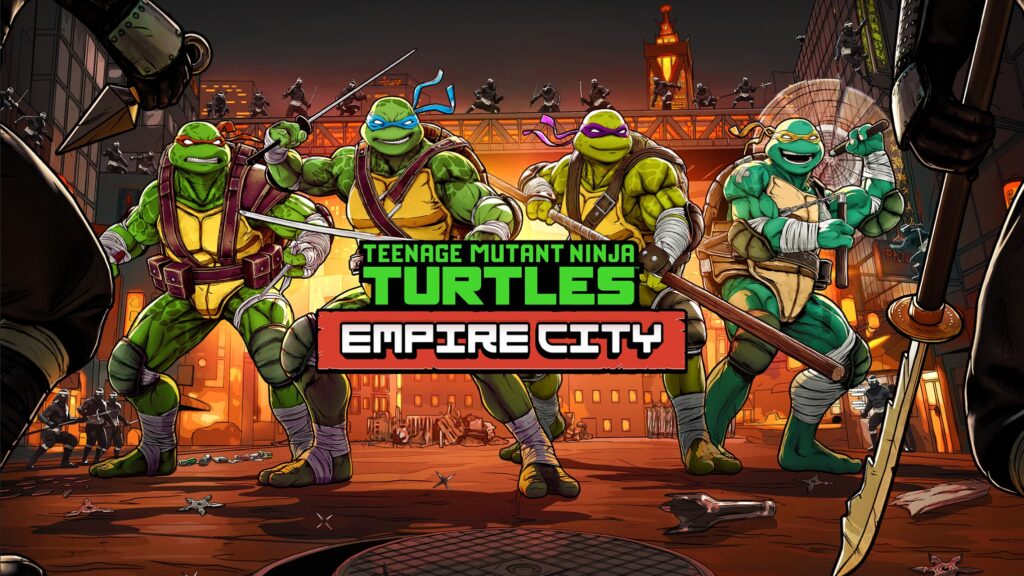
Teenage Mutant Ninja Turtles: Empire City is the first TMNT game built exclusively for VR, and for a franchise that has spent decades in every gaming format imaginable, that distinction matters. Developed by Cortopia Studios — the team behind GORN 2 — and published by Beyond Frames Entertainment, this first-person VR action-adventure drops you directly inside the shell of Leonardo, Raphael, Donatello, or Michelangelo in post-Shredder New York. At its best, Empire City delivers something genuinely exciting: the physical embodiment of being a Ninja Turtle, scaling rooftops and swinging weapons in a way that no flat-screen game can replicate. At its worst, it’s a thin open world that runs out of depth before it runs out of mission markers.
We played Empire City on the Valve Index, which provides a strong technical experience with full finger tracking and precise weapon handling. The story was penned by TMNT comics veteran Tom Waltz, giving the original narrative real franchise legitimacy.

TMNT Empire City’s Best Feature: Being the Turtle
The single most compelling thing Empire City does is make you physically feel like a Ninja Turtle, and it does this better than might seem possible at $24.99. The parkour traversal system — climbing, leaping between rooftops, grabbing ledges, riding zip lines, vaulting over obstacles — is genuinely fluid and satisfying in VR. Running across a New York rooftop, dropping into an alley, and scaling a fire escape feels like something you want to do just to do it, independent of whatever objective is on your map. The comic-book art style reinforces this, creating a world that looks like it was lifted straight from the IDW comics and rendered in immersive scale around you.
Each Turtle plays distinctly. Mikey’s nunchucks reward frantic, high-energy swinging. Donnie’s bo staff favours reach and controlled spacing. Leo’s twin katana demand more precise directional strikes. Raph’s sais suit aggressive close-quarters pressure. The weapons feel physically different in your hands, and choosing a Turtle based on your physical play style rather than preference is a genuinely fun decision that most combat VR games don’t offer.
Combat: Fun but Shallow
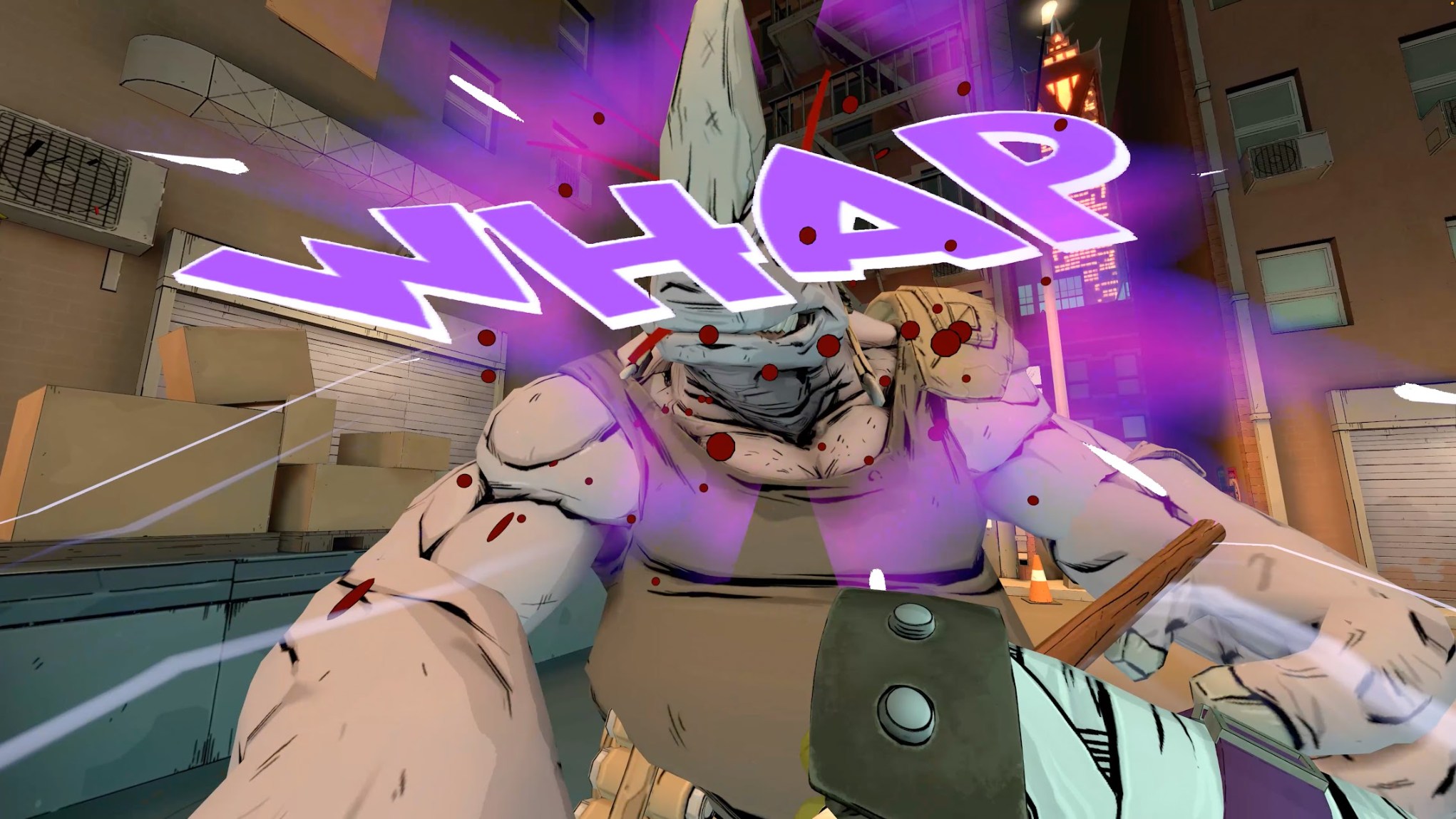
Combat in Empire City is where the most divided opinions live. The system is accessible and immediately satisfying — blocking, striking, and evading Foot Clan soldiers in VR with your actual arms is inherently more engaging than pressing buttons — but it lacks the mechanical depth that the best VR combat games offer. Swinging without much precision still registers as hits, and enemies don’t demand a great deal of strategic positioning outside of boss encounters. Against a single enemy the combat feels good; against groups it can collapse into chaotic arm-waving.
That said, context matters here. Empire City isn’t trying to be Until You Fall or Pistol Whip. It’s a TMNT beat-em-up that happens to be in VR, and on those terms the combat is energetic, readable, and fun in co-op sessions where the chaos becomes part of the charm. Playing Mikey and just flailing at maximum speed is genuinely funny. Playing Donnie and trying to manage spacing is genuinely interesting. The system isn’t shallow by accident — it’s accessible by design, which serves the franchise and the audience well.

Open World Ambition vs. Budget Reality
Empire City’s most significant limitation is the gap between its open-world ambitions and the resources available to fill them. The city streets are sparse — parked cars, pizza drones, and enemy outposts, but very little ambient life. Repeat radio missions cycle through “go here, eliminate enemies, deliver item” with predictable frequency. Indoor combat areas are small enough that four-player co-op occasionally has players crowding around the same target with nowhere else to go. The game tries to mimic the scope of big-budget AAA titles but cannot do so because of its more limited budget, leaving it spread thin over its six-hour length.
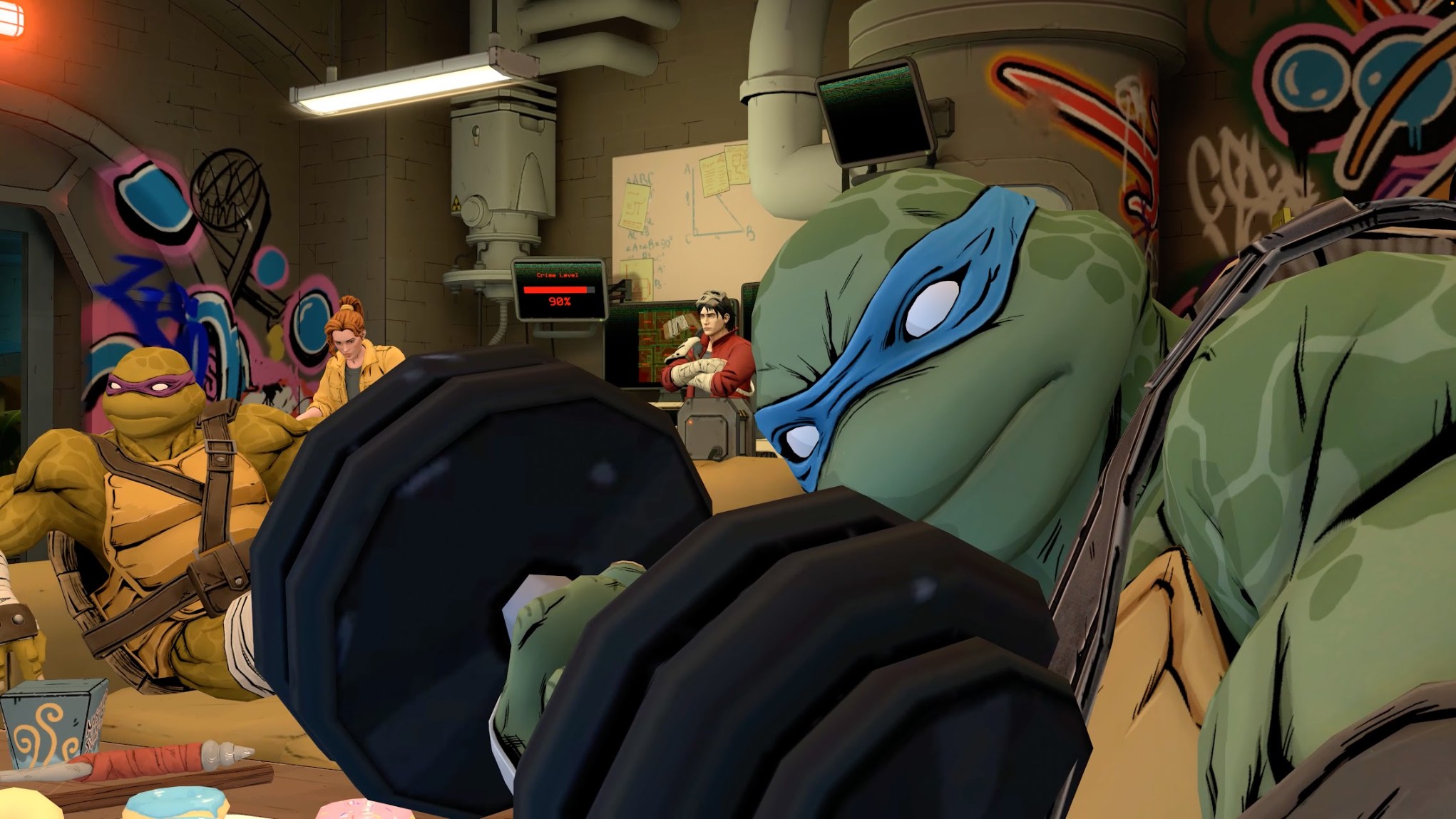
This is a common limitation in VR games at this price point, and recognising it as a budget constraint rather than a design failure is important context. The campaign story missions are stronger than the side quests — well-paced, narratively engaging, and built around the kind of fan-service moments (the Turtle lair, iconic villain appearances, Casey Jones and April’s voice acting) that deliver for franchise devotees. Sticking to the story and treating the open world as optional filler rather than the main attraction significantly improves the experience.
Technical Notes: Valve Index Specific
On the Valve Index, Empire City runs well and the physicality of the Index controllers — full finger tracking, the grip mechanics, responsive haptics — adds to the weapon handling in ways that matter. Some players have flagged the grip button implementation on Index as suboptimal for the game’s design, and a controller mapping option or trigger-based grip alternative would improve quality of life for that platform specifically. Co-op progress currently only saves for the session host, which is a notable omission for players who want to play through the campaign together — something Cortopia should address in an update. Some bugs remain, including occasional geometry clipping and a documented floating/position bug in indoor sections.
The Good, The Bad, & The Ugly
| The Good | The Bad | The Ugly |
|---|---|---|
| Parkour TraversalRunning, climbing, and leaping across New York as a Ninja Turtle in VR is genuinely exhilarating — fluid, responsive, and exactly what this fantasy demands. | Shallow Combat DepthArm-swinging without precision still registers hits, and enemy variety is limited — the combat works as a TMNT beat-em-up but lacks the mechanical depth VR can offer. | Co-op Progress Only Saves for HostA significant design omission that penalises every player in a co-op session except the person who hosted it. Needs patching. |
| Distinct Turtle PlaystylesEach weapon type plays physically differently and suits different real-world movement styles — choosing your Turtle by how you want to move is a smart, fun decision. | Sparse Open WorldThe city streets lack ambient life, and the radiant quest loop — go here, kill enemies, deliver item, repeat — becomes repetitive across the game’s full runtime. | |
| Authentic TMNT AtmosphereTom Waltz’s story, the Turtle lair, iconic villain appearances, strong April and Casey voice work — this feels like a real TMNT game made by people who love the franchise. | Cramped Co-op Indoor AreasIndoor sections are small enough that four players regularly crowd around the same enemy with limited tactical space — co-op works better in outdoor areas. | |
| Outstanding Value at $24.99Six hours of story campaign, four distinct playable Turtles, four-player co-op, and genuine franchise authenticity at a price that makes it a natural VR library addition. |
The Verdict
Teenage Mutant Ninja Turtles: Empire City is the best TMNT VR game that could realistically be made at this budget, and for the franchise’s VR debut, that’s more than good enough. The parkour traversal is excellent, the Turtle weapon differentiation is smart, the story is legitimately written, and the co-op chemistry — when it works — is exactly the kind of chaotic fun the franchise deserves. The shallow combat, sparse open world, and co-op progress bug are real limitations that keep it from being more.
At $24.99 for VR owners who have friends to play with, Empire City is easy to recommend. Solo players without TMNT nostalgia may find the experience thinner. We’re looking forward to revisiting this on the Steam Frame when it arrives — a more capable headset may push the experience closer to its potential. For more VR and action game coverage, check out our full reviews section.