


The Ultimate Dopamine Trap
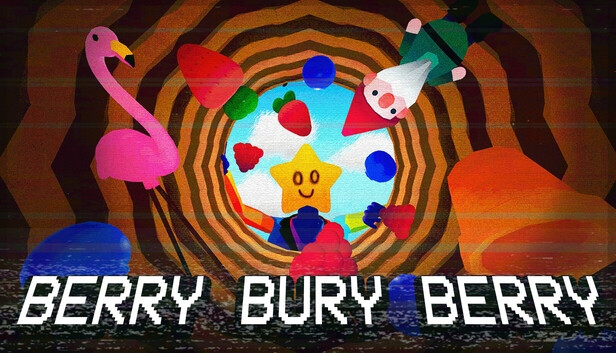
Incremental “clicker” games and psychological mascot horror are two genres that, on paper, should mix like oil and water. One is designed to lull your brain into a state of deep, satisfying automation, while the other exists solely to keep you on edge. Yet, independent studio Get(Color) Games has managed to perfectly synthesize both into Berry Bury Berry.
Released in late January 2026, this bizarre, first-person adventure drops you into a walled-off, highly saturated low-poly garden with a simple directive: grow berries, and throw them into a giant, ominous hole.
With an “Overwhelmingly Positive” consensus across nearly 3,000 Steam reviews, the game has rapidly become a viral sensation. It is the type of experience that completely hijacks your executive function, compelling you to stay up until 3:00 a.m. mumbling about harvest efficiencies and sentient strawberries. But beyond the vibrant colors and the satisfying plop of fruit hitting the bottomless pit, there is a surprisingly poignant narrative beating at the heart of this accursed garden.

Number Go Up
The mechanical foundation of Berry Bury Berry is beautifully simple, drawing heavily on physics-based puzzlers like Donut County and the granddaddy of all idlers, Cookie Clicker.
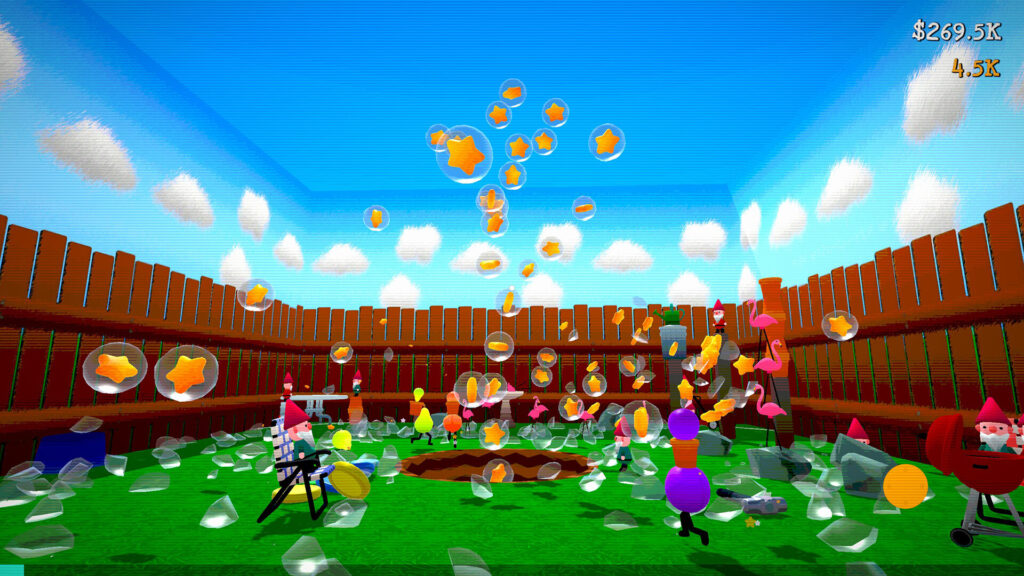
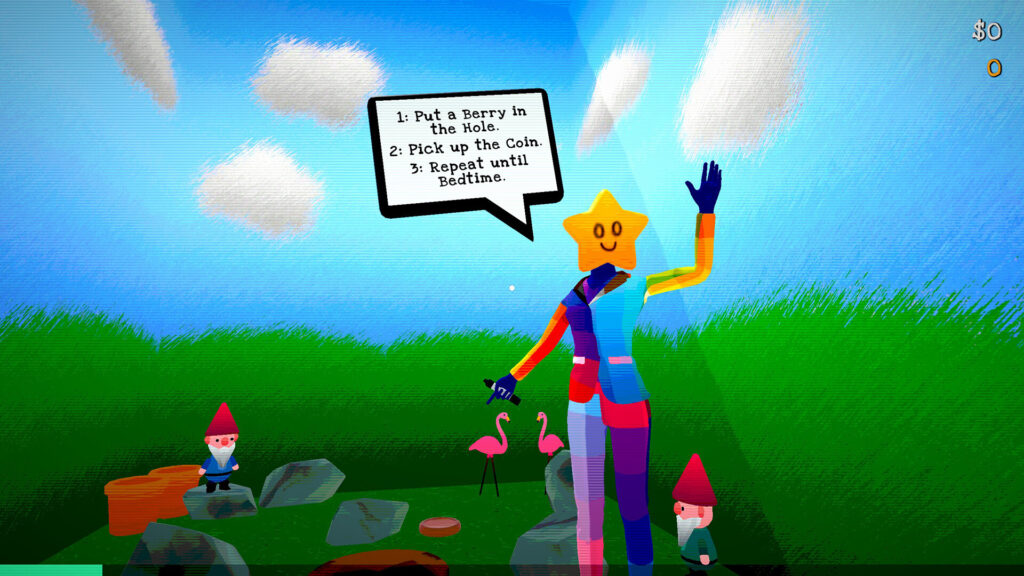
You begin with a basic fruit dispenser, a patch of grass, and a dark hole. When you toss a berry into the void, a coin shoots back out. You use those coins to unlock an expansive upgrade tree. Soon, you are purchasing tools to harvest faster, upgrading the tier and value of the berries you grow, and eventually unlocking “Berry Buddies”—sentient, incredibly cute fruit pals who waddle around the garden helping (or sometimes hindering) your production lines.
However, unlike traditional idle games, Berry Bury Berry refuses to be fully automated. You cannot just leave the game running in the background and go make a sandwich. The game requires your active participation. You have to physically navigate the space, organize your Berry Buddies, solve environmental puzzles, and chuck the harvest into the abyss yourself.
As you progress, the hole grows. The garden expands. You uncover hidden shelves, locked doors, and trash bins that require light puzzle-solving to access. The progression is meticulously paced; just as the manual labor starts to feel slightly repetitive, the game introduces a new gadget, a new area, or a new piece of the story to keep you hooked.
When the Sun Goes Down
While the daytime cycle in the garden is bouncy, colorful, and accompanied by catchy electronic radio tunes, the game’s “Psychological Horror” tag earns its keep when the sun sets.
The transition to night brings an immediate, uncanny shift in the atmosphere. The cheerful aesthetic begins to feel deeply isolating. It becomes apparent that you are walled in. The Berry Buddies staring at you with their simple, unblinking faces begin to look less like helpful friends and more like cursed captives. The hole itself feels less like a game mechanic and more like a hungry, malevolent entity demanding to be fed.
Get(Color) Games shows remarkable restraint with its horror elements. Rather than bombarding the player with cheap jump scares or relentless monster chases, the fear here is purely atmospheric and liminal. It is the creeping realization that nobody ever leaves this garden, and that feeding the hole might be doing far more harm than good.
Art, Greed, and the Abyss
The story of Berry Bury Berry is entirely optional, delivered primarily through audio cassette tapes hidden around the expanding environment. If you just want to focus on maximizing your berry profits, you can safely ignore them. But if you stop and listen, you will find a surprisingly sharp critique of the modern creative industry.
The audio logs detail the story of “Donna,” a passionate creative who dreamed of writing, directing, and starring in her own children’s television show. Her dreams are systematically crushed by a ruthless producer enforcing budget cuts on behalf of faceless studio executives. Her passion project is cheapened, stripped down, and ultimately ripped away from her to save a few dollars.
As players dive deeper into the tapes, Donna’s story spirals into a dark tale of revenge, arson, and madness. But the core theme remains razor-sharp: Berry Bury Berry is an allegory for the defunding of public arts and education. It mirrors the real-world anxieties surrounding corporate cost-cutting, in which passion and human creativity are constantly sacrificed at the altar of profit margins.
The developer makes their stance on this issue explicitly clear. Upon reaching the end of the game, players are greeted with a title card that proudly declares: “Berry Bury Berry was proudly made without AI Gen’d assets. Art by humans, for humans.” In an industry currently grappling with the ethics of automated content generation, this fierce dedication to human-crafted art gives the game’s narrative a profound, resonant weight.
Performance and Pacing
From a technical standpoint, the game runs flawlessly. It is highly optimized, requiring a mere 600 MB of storage space and incredibly forgiving system requirements. It is officially marked as “Playable” on the Steam Deck, making it the perfect title to curl up with on the couch for a long evening session.
Perhaps the game’s greatest strength is its runtime. A standard playthrough will take roughly 4 to 6 hours, while completionists hunting down all 61 achievements and multiple endings can expect to spend around 8 hours in the garden. For an incremental game, this is the perfect length. It allows the player to experience the full, satisfying arc of zero-to-hero progression without overstaying its welcome and devolving into a mindless, infinite slog.
The Good, The Bad, & The Juicy
| The Good | The Bad | The Ugly |
| The Gameplay Loop: Throwing fruit into the hole and buying upgrades is viscerally satisfying and highly addictive. | Predictable Tropes: The “corrupted children’s media” mascot horror trope is beginning to feel a bit overused in the indie space. | No Full Automation: If you want a purely passive idle game to run in the background, this hands-on approach might frustrate you. |
| The Narrative: A poignant, sharply written critique of corporate greed and the devaluation of human-made art. | Short Runtime: Some players might find the 5-hour campaign too brief for a genre built on infinite scaling. | |
| Visuals & Audio: The highly saturated, low-poly art style perfectly contrasts the dark, uncanny nighttime atmosphere. | ||
| The Value: At just $7.99, it offers a complete, bug-free, and thoroughly polished experience. |

Should You Buy It?
Yes, if: You loved the physics-based hole-growing of Donut County, you suffer from a crippling addiction to incremental games like Cookie Clicker, and you appreciate anti-corporate indie art.
No, if: You are looking for a genuinely terrifying horror game packed with jumpscares, or you despise games that require repetitive manual labor to progress.
Recommended for fans of: Donut County, Slime Rancher, My Friendly Neighborhood, Katamari Damacy, Cookie Clicker.
Berry Bury Berry: Berry Bury Berry is a masterclass in unexpected genre blending. It traps you with the irresistible, dopamine-dripping mechanics of an incremental clicker, only to pull the rug out from under you with a dark, deeply human story about the devaluation of art. It is weird, it is funny, and it is just a little bit terrifying. For the incredibly low price of $7.99, Get(Color) Games has delivered one of the most mechanically satisfying and thematically cohesive indie titles of 2026. Just remember to occasionally look up from the screen to make sure a giant, gaping hole hasn't opened up in the middle of your living room. – Flare