


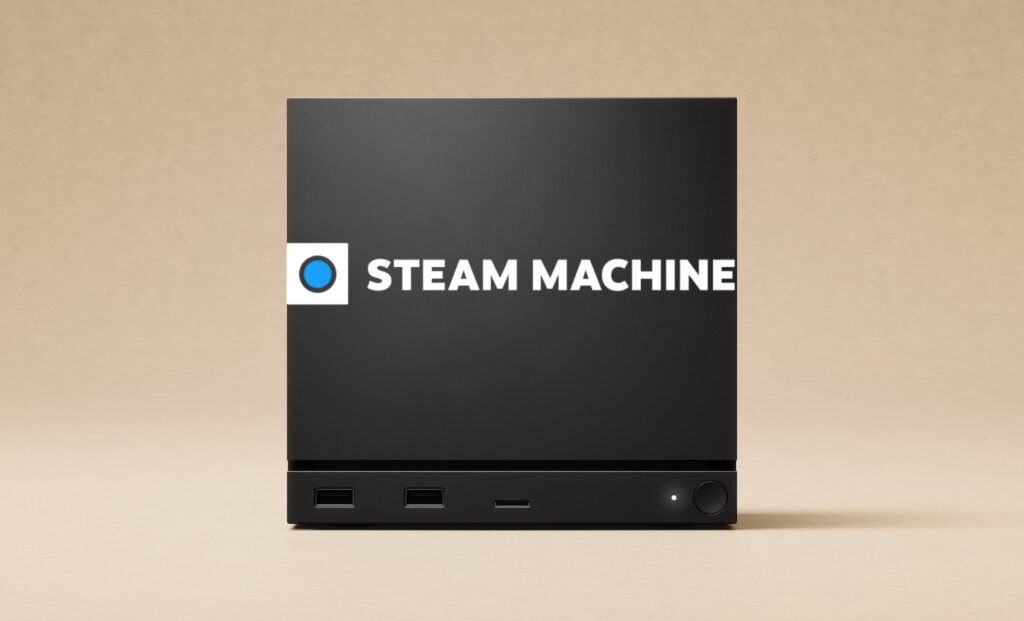
It’s finally here. Valve’s Steam Machine launches today, June 22, 2026 — a compact, roughly 6-inch cube running SteamOS that Valve is positioning as PC gaming’s answer to the living room console. Four configurations are available, from a $1,049 512GB base model to a $1,428 2TB bundle with the Steam Controller included, and reservations are open right now via a randomised sign-up process designed to limit resellers. The signup window closes June 25 at 10am Pacific.
This is the second time Valve has attempted to bring SteamOS to the living room — the original Steam Machines of 2015 never caught on, hampered by limited game compatibility and a fragmented hardware ecosystem. A decade of work on Proton, Valve’s Windows-to-Linux compatibility layer, changes that equation dramatically. Nearly any Windows game on Steam now runs on SteamOS without command-line configuration, driver conflicts, or manual setup — the same technology that has powered the Steam Deck since 2022.

Pricing — All Four Options
All prices include VAT where applicable. The Steam Machine ships directly via Steam in the US, Canada, UK, EU, and Australia. In Japan, Taiwan, and Hong Kong, it will be available through KOMODO, an authorized distributor.
What’s Inside


How to Reserve Yours — Sign Up Before June 25
Valve is using a randomised reservation system to manage launch allocations and limit resellers. Here’s how it works:
- 1Head to store.steampowered.com/hardware/steammachine and sign up for the configuration you want. You can sign up anytime before June 25 at 10am Pacific.
- 2At 10am Pacific on June 25, Valve closes signups and runs a one-time randomisation to determine reservation order.
- 3On June 25, you receive an email telling you either: you’ve been added to the reservation queue and a unit is reserved in your name, or you’ve been added to the waitlist for when more units become available.
- 4The first batch of purchase emails go out on Monday June 29. Valve continues through the reservation queue as units become available.
The Steam Machine is upgradeable (RAM and SSD), open to any OS (though SteamOS unlocks the best features including HDMI CEC and instant suspend/resume), and works with any USB or Bluetooth peripheral out of the box. No closed ecosystem, no peripheral licensing requirements.