


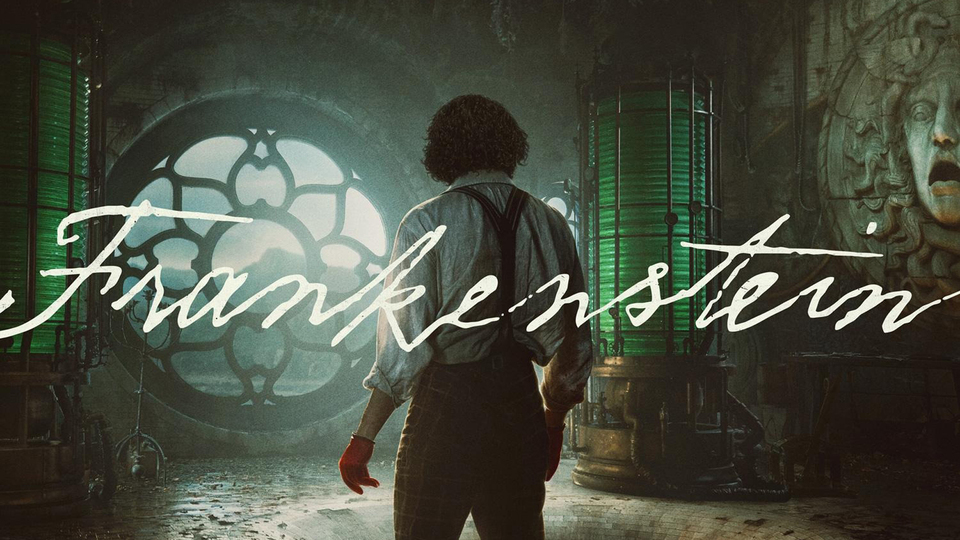
Guillermo del Toro has been threatening to make his version of Frankenstein for nearly two decades. It is the ultimate passion project for a director who built his career on sympathizing with monsters. Now, arriving on Netflix with a massive $120 million budget, Frankenstein attempts to wrestle Mary Shelley’s 1818 gothic masterpiece into a new form.
Here at TheBigBois, we sat down to watch this 2.5-hour epic. What we found was a film of staggering visual beauty that unfortunately strips away the complex morality of the source material in favor of a more black-and-white narrative.
A Gothic Feast for the Eyes
If there is one reason to watch this film, it is the artistry. In an era of muddy CGI and green screens, Frankenstein feels tactile, expensive, and grounded. Del Toro treats every frame like a Renaissance painting. The gothic architecture, the frozen wastelands, and the intricate costumes are immaculate.
The creature design deserves special praise. Moving away from the classic “bolts in the neck” Boris Karloff imagery, this Monster (Jacob Elordi) is a gruesome patchwork of skin, sinew, and bone. The animation sequence—the “It’s Alive” moment—is reinvented here not as a lightning strike on a slab, but as a terrifying fusion of a nervous system and skeleton. It is body horror at its finest, grounding the resurrection in biology rather than just electricity.
The Monster and The Man
The film adopts an interesting structure, splitting the narrative perspective between the creator, Victor Frankenstein (Oscar Isaac), and his creation.
Oscar Isaac plays Victor with a manic, sweaty intensity. This is not a misunderstood scientist; he is a narcissist driven by pure ego and ambition. The film leans heavily into an Oedipus complex interpretation, featuring bizarre recurring shots of Victor drinking milk that feel a bit heavy-handed. You love to hate him, but he lacks the tragic nuance of the book’s counterpart.
On the other side, Jacob Elordi’s Monster is portrayed almost as a paragon of innocence—a “Disney Princess” who befriends animals and only lashes out in self-defense. While Elordi’s physical performance is impressive, the script robs the character of his menace. The moral gray area that makes Shelley’s novel so compelling—where both creator and creation are villains in their own right—is replaced here by a simple “Bad Guy vs. Good Guy” dynamic.
Wasted Potential
The supporting cast is a mixed bag. Christoph Waltz shines as a benefactor suffering from syphilis, adding a layer of grotesque human decay to the story. However, Mia Goth is criminally wasted as Elizabeth. Talented as she is, her character is reduced to a rushed plot device with motivations that feel unearned, particularly her sudden fascination with the creature.
Furthermore, the pacing drags significantly over the 150-minute runtime. There are moments of brilliance, such as the Monster’s interactions with a blind man. Still, they are often bookended by sluggish exposition or jarring narrative choices, like the Monster suddenly displaying “Wolverine-level” healing factors during a shootout.
Frankenstein is undeniably superior to recent failed attempts at the IP (looking at you, Dark Universe), but it feels like a missed opportunity to tell a deeper story. Del Toro proves once again that he is a master of atmosphere. Still, by simplifying Victor and his Creature’s morality, the film loses the philosophical soul that makes the story timeless.
| The Good | The Bad |
| Visual Mastery: Immaculate sets, lighting, and costuming that feel expensive and real. | Simplistic Morality: Removes the “gray area” of the novel; Victor is too evil, the Monster is too good. |
| Creature Design: A gruesome, biological take on the monster that emphasizes sinew and bone over bolts. | Pacing: At 2.5 hours, the film drags in the middle and suffers from slow narrative progression. |
| Oscar Isaac: Delivers a manic, intense performance that anchors the film, even if the writing fails him. | Wasted Talent: Mia Goth is given very little to do, with a rushed and unconvincing character arc. |
| The Score: Alexandre Desplat delivers a haunting, atmospheric soundtrack. | Plot Holes: Distracting logic jumps, including bad wolf CGI and inexplicable castle architecture. |
Frankenstein (2025): Guillermo del Toro’s Frankenstein is a triumph of production design and atmosphere, but it stumbles with its storytelling. While it is a treat to look at, the "Disneyfication" of the Monster and Victor's cartoonish villainy robs the narrative of its tragic complexity. It is worth a watch for the craft alone, but don't expect it to replace the novel (or the 1931 classic) in your heart. – Asmodeus