


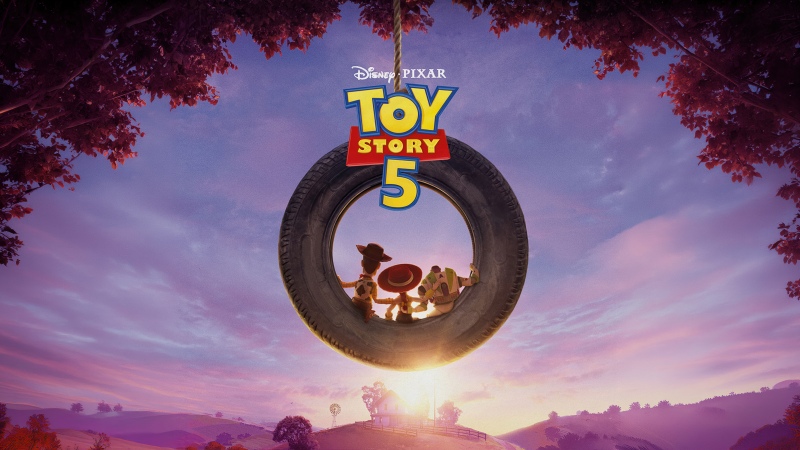
Toy Story 5 arrives seven years after the fourth entry with a question at its centre that feels more honest than it has any right to: in a world where children have traded their toys for tablets, do toys still matter? The answer that Andrew Stanton — returning to the franchise he helped build — delivers is complicated, emotionally rigorous, and surprisingly willing to sit with the sadness of that question before resolving it. This is better than Toy Story 4. It’s the best Pixar has felt in years.
The film earns a CinemaScore of A, 94% on Rotten Tomatoes, and a $71 million opening day — the second highest opening day in history for an animated film, behind only The Incredibles 2. Those numbers suggest the audience has found something here that connects, and having seen the film, the reason is clear: Toy Story 5 is about something real, and it knows it.
Cast
Jessie’s Movie — And That’s the Right Choice
Toy Story 5 is, more than any previous entry, Jessie’s film. Woody remains present but steps back — he’s on the periphery with Bo Peep’s lost-toy rescue mission, appearing when needed and departing when the story no longer requires him. That structural decision allows Joan Cusack’s Jessie to carry the emotional weight of the film, and the film is stronger for it. Jessie’s specific wound — having been loved and abandoned by a child before, twice now, and facing it possibly happening a third time with Bonnie — is the engine the story runs on.
Bonnie, in this film, is a shy child who struggles to make friends. Her parents buy her a tablet to help her connect with other kids, and she becomes immediately absorbed in it. The toys watch this happening and feel the displacement acutely — not with anger, but with the particular kind of sadness that comes from being replaced by something that doesn’t understand what it’s replacing. The antagonist, Lilypad, is voiced by Greta Lee as a tablet AI who genuinely believes she is helping Bonnie — and that moral ambiguity is the film’s most interesting creative choice. Lilypad is not a villain. She’s just wrong about what Bonnie needs.

The Comedy — Conan O’Brien Steals Every Scene
Conan O’Brien voices Smarty Pants, a potty-training toy who becomes the film’s unexpected comedic centrepiece, and his performance is a genuine highlight of the entire Toy Story franchise. The character is introduced running low on batteries and acting erratically, comes alive when recharged, and delivers a running series of jokes that operate on two levels simultaneously — innocent enough for children, specific enough for adults to catch what they’re actually saying. He’s the equivalent of Ken in Barbie: a supporting character who comprehends exactly what kind of movie he’s in and acts accordingly.
The imagination sequences — moments when children play with toys and the film renders those internal fantasies as full cinematic reality — are the best version of something Toy Story has always done well. When Bonnie eventually plays with the farm girl Blaze’s toys, the resulting sequence mixes the regular cast with the new tech toys in an imagination scenario that includes Conan O’Brien’s character as a bumbling secret agent. It is, simply, delightful.
The Emotional Core
The most affecting moment in Toy Story 5 is quieter than almost anything in the franchise’s history. Jessie, at her lowest point — having been rejected by a child for the third time in her existence — sits beneath a tree on a rural property and finds, carved into the bark, the name of her original owner Emily. Emily had a daughter. Emily named her daughter Jessie. The toy that Emily grew out of and gave away had stayed with her long enough to name a child. That moment — the revelation that a child’s love for a toy can echo forward through decades — is handled with exactly the restraint it deserves, and it is the scene that earns the whole film.


The Good, The Bad, & The Ugly
| The Good | The Bad | The Ugly |
|---|---|---|
| A Premise That Earns Its EmotionToys versus tech is not a gimmick — it’s a genuine meditation on childhood, imagination, and what gets lost when children stop playing. The film takes its premise seriously and the emotion lands because of that. | Woody Is UnderservedTom Hanks is present but peripheral. After four films as the emotional anchor, giving Woody a reduced role is a defensible structural choice — but fans expecting a Woody story will find him largely decorative here. | The Buzz Lightyear Subplot Takes Time to ClickA shipment of new Buzz Lightyear units with drone capabilities and Wi-Fi opens the film, and the connection between that storyline and the main plot takes longer to earn than ideal — though the payoff is legitimate. |
| Conan O’Brien Is an All-TimerSmarty Pants is the funniest new Toy Story character in the franchise’s history. Conan O’Brien’s performance operates on multiple levels simultaneously and steals every scene he’s in. | Lilypad’s Arc Deserved More TimeThe decision to make Lilypad a well-intentioned antagonist rather than a genuine villain is the right one, but her arc resolves quickly. More time spent with her perspective would have deepened the film’s central tension. | |
| The Jessie Tree SceneThe moment where Jessie discovers Emily’s daughter was named after the toy her mother loved is the best scene in the franchise since the incinerator in Toy Story 3. Quiet, earned, devastating, and hopeful. | ||
| Taylor Swift’s “I Knew It, I Knew You”The original song was reportedly written in a single sitting and it shows — it understands the film it was written for, and the end-credits sequence built around it is beautifully designed. |
The Verdict
Toy Story 5 is the rare late franchise entry that justifies its own existence not through nostalgia or spectacle but through emotional honesty. Andrew Stanton understands what made the original trilogy work — the films were never really about toys, they were about what it means to be loved and to be left behind — and he has found a genuinely new angle on those themes in the tablets-and-toys generational divide. The imagination sequences are the best in the franchise. Conan O’Brien is extraordinary. The Jessie storyline earns every moment of screen time it’s given. And the film as a whole lands an emotional punch that most animated films twice its ambition never manage.
Better than Toy Story 4. Not quite the trilogy’s perfect three-film run — but closer than it had any right to be. Take your family. Take yourself. The toys are worth it.
For more movie reviews, check out our full reviews section.