



For decades, the video game industry has conditioned us to play the hero. We are the ones kicking down the dungeon doors, dodging the spike pits, and slaying the terrible beasts lurking in the dark for a chest full of gold. But what if the beast was tired of being hunted? What if the monster decided to fight back with a little architectural ingenuity?
Published by the always-eccentric Devolver Digital and developed by Artificer, MINOS flips the traditional fantasy script entirely on its horned head. Released last week, this genre-bending indie title casts you as the fabled Minotaur, tasked with defending your labyrinthine sanctuary from endless waves of glory-hungry adventurers.
Currently sitting at a “Very Positive” rating on Steam, MINOS is an incredibly refreshing surprise. It refuses to be boxed into a single category, existing somewhere in the brilliant, chaotic intersection of a tower defense game, a roguelite, and a hardcore puzzle simulator. If you have an open mind and a penchant for building elaborate death traps, this is a maze you will gladly lose yourself in.

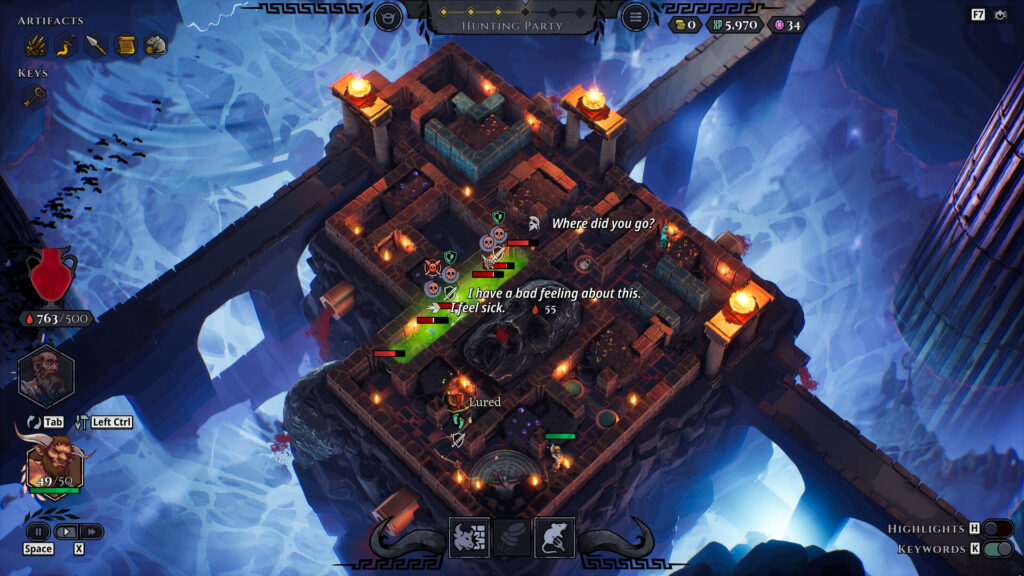
Building the Perfect Death Trap
At its core, MINOS is a game about spatial optimization and cruel efficiency.
Before the bloodthirsty adventurers breach your sanctuary, you are given the opportunity to drag walls, gates, and corridors into place to shape the layout of your labyrinth. Your ultimate goal is to protect your inner sanctum (and your own hide) by ensuring the heroes never make it through the maze alive.
The trap mechanics are where the game truly ascends from a standard tower defense title into a deeply satisfying puzzle game. You are not just placing static turrets that shoot arrows at passing enemies; you are engineering complex, interconnected Rube Goldberg machines of death.
Every spike, boulder, swinging blade, and fire trap can be linked together. You can place a pressure plate that triggers a shifting gate, trapping a knight in a rotating passage, which subsequently drops a boulder that crushes him into a wall of spikes. Fooling the AI into thinking they have successfully navigated a corridor, only to drop the floor out from under them, provides a wicked sense of satisfaction. Because you have the freedom to split the heroes up, confuse their pathfinding, and dictate the flow of the waves, the strategic ceiling here is remarkably high.
The Roguelite Loop and Metaprogression
Because MINOS incorporates heavy roguelite elements, the game embraces the philosophy that failure is just another stepping stone to success.
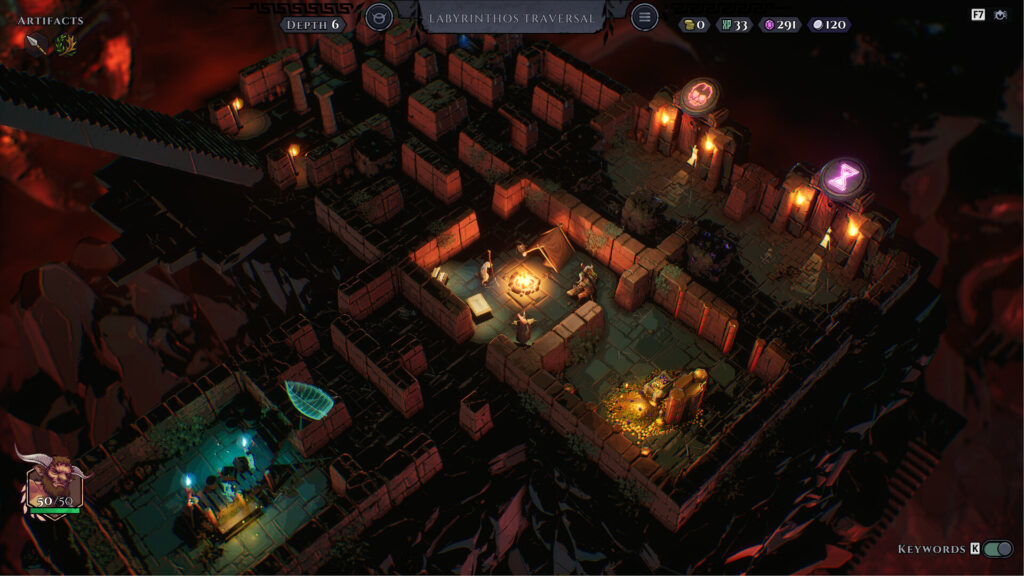
Every “run” or night in the labyrinth brings a newly generated set of challenges. You will encounter different enemy types, be offered varying pools of traps via RNG (Random Number Generation), and face entirely new architectural layouts. Sometimes, the RNG will not be in your favor. You might find yourself facing heavily armored troops without the necessary armor-piercing traps, resulting in the adventurers finally besting you.
However, the game is incredibly forgiving in its metaprogression. You aren’t forced into a frustrating, absolute hard reset. The resources and knowledge you gather during a failed run carry over, allowing you to unlock permanent upgrades and better starting conditions for your next attempt. This creates a dangerously addictive “just one more run” loop that will easily keep you glued to your monitor for hours.


Audio, Story, and the Human-Faced Minotaur
While the gameplay takes center stage, MINOS’s presentation holds its own. The game features excellent, full voice acting and rich audio design that make every triggered trap sound appropriately devastating. The overarching narrative—which delves into the tragic history of Daedalus, the creation of the maze, and the impending arrival of Theseus—isn’t overly deep, but it provides a compelling enough backdrop to justify your murderous rampage.
However, there is one glaring aesthetic choice that has left players scratching their heads: the character design of the Minotaur himself.
Instead of a terrifying, hulking beast with the brutal head of a bull, the protagonist’s design leans awkwardly close to a handsome, human-faced Satyr. For a game deeply rooted in Greek mythology about a legendary monster, the surprisingly human face of the Minotaur feels like a strange, slightly disappointing misstep in art direction.
Dismantlers and Quality of Life
Despite its brilliance, MINOS has a few rough edges that desperately need a quality-of-life patch.
The most prominent frustration stems from the game’s UI and visual clarity. When you have eight or nine pressure plates linked to various traps across a massive maze, it becomes incredibly tedious to track which plate triggers which trap. The game desperately needs a color-coded link visualization tool. Furthermore, the visual distinction between permanent walls and temporary, player-placed walls can be incredibly difficult to parse, especially in low-light conditions, which is especially tough for visually impaired players.
On the gameplay balance side, the game introduces an enemy class called “Dismantlers.” These enemies can actively disable your carefully placed traps. While this adds a necessary layer of challenge, the Dismantlers currently feel overtuned. If you suffer from bad RNG and don’t receive the specific traps needed to counter them (like the Ballista), a wave of Dismantlers will effortlessly tear through your entire maze, forcing you to drain your own HP to hastily rebuild. A slight cooldown on their dismantling ability would go a long way in smoothing out the late-game difficulty spikes.
The Good, The Bad, & The Mythological
| The Good | The Bad | The Ugly |
| Trap Mechanics: Chaining pressure plates, boulders, and shifting gates into elaborate kill boxes is endlessly satisfying. | Visual Clarity: Tracking complex trap linkages is a headache, and different wall types can blend together visually. | The Minotaur Design: The protagonist looks more like a handsome, human-faced Satyr than a terrifying mythical bull-monster. |
| The Genre Mashup: Flawlessly balances tower defense strategy, puzzle-solving optimization, and base building. | Dismantler Enemies: Enemies that instantly destroy your traps feel slightly overtuned and frustrating to deal with. | |
| Metaprogression: The roguelite progression is forgiving, ensuring that failed runs still reward you with permanent upgrades. | RNG Dependency: Bad luck with trap drops can occasionally leave you defenseless against specific enemy types. | |
| Performance: Runs flawlessly out of the box, with full controller support and a Steam Deck Verified rating. |

Should You Buy It?
Yes, if: You love deep tower defense games (like Orcs Must Die!), you enjoy the “just one more run” addiction of roguelites, or you want a strategy game that requires genuine puzzle-solving logic.
No, if: You expect a pure, traditional action-roguelike (like Hades), you hate relying on RNG for your defensive options, or you get frustrated when enemies can actively destroy your carefully laid plans.
Recommended for fans of: Orcs Must Die!, Dungeon Keeper, Meet Your Maker, Kingdom Two Crowns, Loop Hero, Slay the Spire.
MINOS: MINOS is a masterclass in genre-blending. Artificer has successfully combined the strategic foresight of a puzzle game with the chaotic, trap-springing joy of a classic tower defense, all wrapped in a highly addictive roguelite shell. While the UI needs a few quality-of-life updates to improve visual clarity, and the Dismantler enemies can feel a bit cheap when the RNG turns against you, the core foundation here is exceptionally strong. If you have ever wanted to play the villain and design the ultimate dungeon of doom, MINOS is easily one of the best strategy games of 2026. – Obsidian