


The Metroidvania genre is a crowded galaxy. To stand out amongst the stars—especially in a timeline where we are finally “eating good” with heavy hitters like Hollow Knight: Silksong dominating the conversation—an indie title needs more than just a map and a double jump. It needs a soul. It needs an aesthetic that arrests the senses and a gameplay loop that refuses to let go.
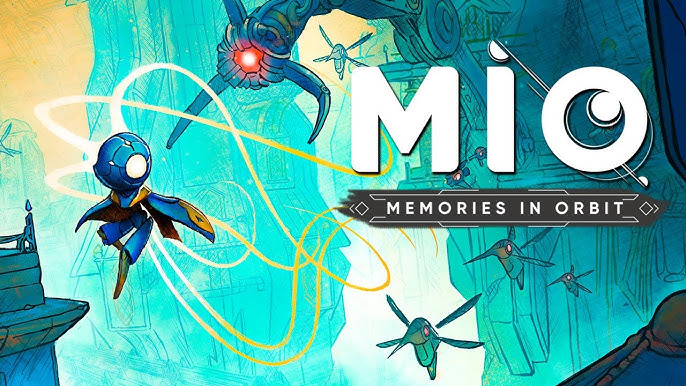
Enter MIO: Memories in Orbit, the latest offering from Douze Dixièmes and Focus Entertainment. Released today, January 20, 2026, this sci-fi adventure tasks players with stepping into the metallic shell of MIO, a nimble android awakening on “The Vessel”—a colossal, decaying spaceship drifting aimlessly through the void.
After spending roughly 15 hours grappling, gliding, and slashing my way through this technological labyrinth, I’ve come to a conclusion: MIO is a work of art that occasionally stumbles over its own ambition, but picks itself up with such grace that you can’t help but keep playing.

The Vessel: A Masterpiece of Decay
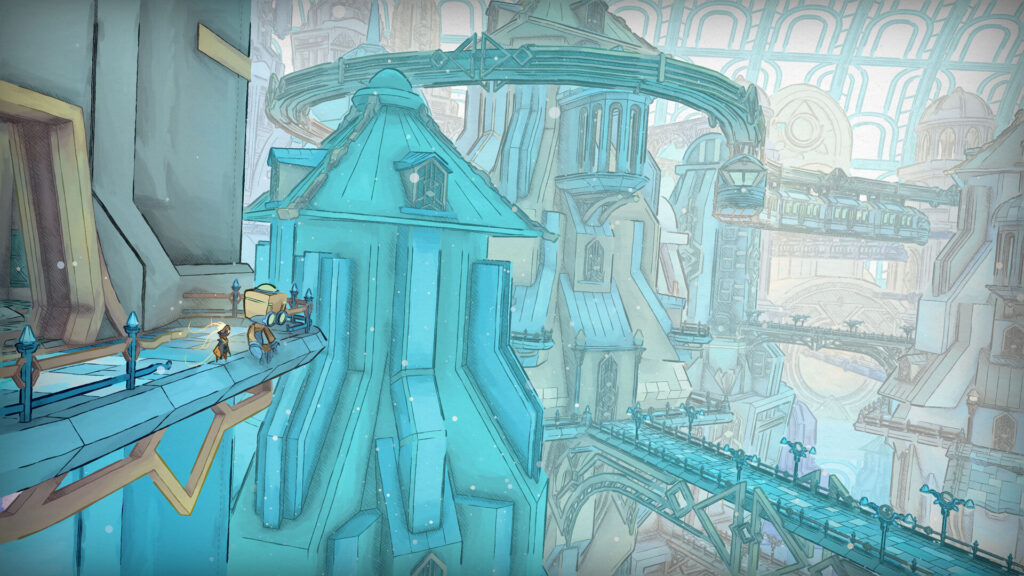
The first thing that strikes you about MIO is the visual language. It is, quite simply, stunning. The developers have cited comics, paintings, and anime as inspirations, and the result is a world that feels hand-crafted and alive. The Vessel isn’t just a backdrop; it’s a character. It is an overgrown technological ark, a mesh of cold steel and vibrant, invasive vegetation.
The art style utilizes a unique color palette that pops against the deep blacks of space and the dark corridors of the ship. Every zone feels distinct, from the industrial hum of the core to the overgrown gardens where machines have gone rogue. As one reviewer noted, it is “a true gift for the eyes.”
Complementing this visual feast is a soundtrack that might be one of the best of the year. It blends lo-fi beats with haunting choral melodies, creating an atmosphere that is equal parts relaxing and melancholic. It perfectly captures the loneliness of being a small robot in a massive, dying machine. Even when the gameplay slows down, the vibe keeps you engaged.
The Flow of Movement
In a Metroidvania, movement is king. MIO understands this, though it demands patience from the player. The early game can feel a bit sluggish. MIO starts vulnerable and grounded, and the initial pacing is deliberate—perhaps too deliberate for those seeking high-octane action right out of the gate. As one user review warned, “I saw no signs of it picking up in 20-30 minutes.”
However, sticking with it pays dividends. Once you begin to unlock MIO’s arsenal of traversal abilities, the game transforms. The grappling hook, air gliding, and spider-like wall clinging turn the environment into a playground. The level design encourages “flow”—a state of rhythmic movement in which you chain abilities to navigate complex hazards without touching the ground.
When you are swinging through a corridor, dodging lasers, and wall-running up a shaft in one fluid motion, MIO feels incredible. It captures that specific “flow state” gaming that genre veterans crave.
Combat: Chips and Choices
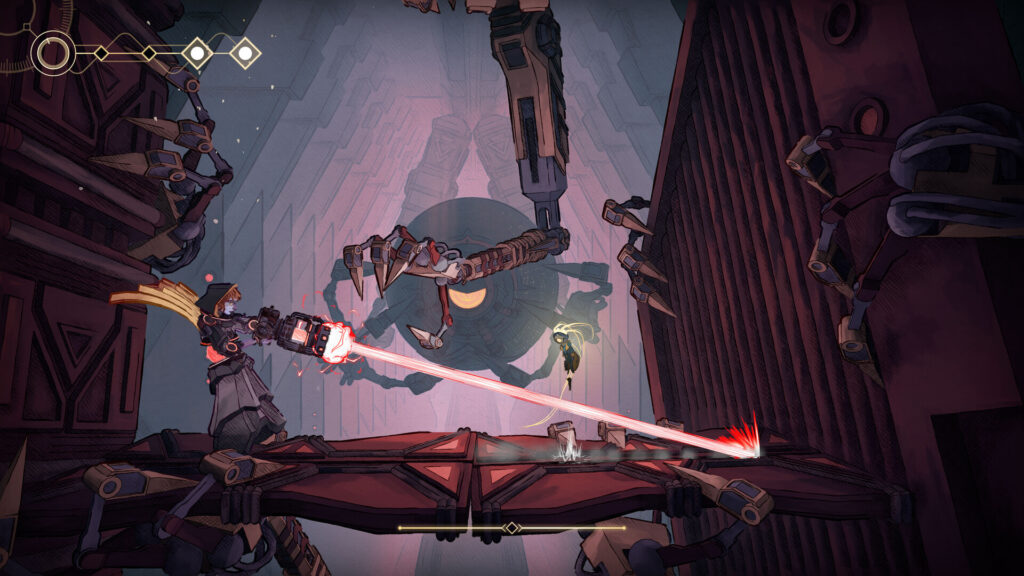
Combat in MIO is tight, responsive, and surprisingly customizable. You face off against over 30 enemy types and 15 bosses, ranging from the relentless “Mosquito” (whose sound design is annoyingly realistic) to the menacing Scarecrow.
The combat system borrows a page from Nier: Automata with its customization. You scavenge components to enhance MIO’s abilities using “Modifiers.” This allows for a flexible playstyle. Do you want to sacrifice your shield to boost your damage output? Do you want your grappling hook to act as a deadly lasso or an evasion tool?
However, there are some mechanical quirks that might frustrate purists. The most contentious decision is the “Pogo” mechanic. You can bounce off enemies, Hollow Knight style, but it does no damage. It is purely a movement tool. For players trained to use downward slashes as an offensive weapon, this requires a significant mental adjustment. Additionally, the dodge mechanic—a stationary “puff” rather than a directional dash—feels unintuitive at first and takes time to master.
The Labyrinthine Struggle
If MIO has a significant flaw, it is its lack of respect for the player’s time during traversal. The Vessel is massive, and in the early to mid-game, it can feel punishingly large.
“Loads of walking,” notes a Steam reviewer. “I’m afraid you get no save points close to bosses.”
The lack of a robust fast-travel system early on can make backtracking a chore. While the shortcuts are clever and the world is interconnected, the sheer distance between objectives can sometimes drag the pacing down. Furthermore, the healing system is tied to currency—you pay to restore shields at specific stations—which adds a layer of resource management stress that feels unnecessary in a game that thrives on exploration.
Additionally, while the art is beautiful, it can sometimes obscure gameplay elements. In the heat of battle, it isn’t always immediately clear what is a background element and what is a hazard that will hurt you.
Performance on Steam Deck
For handheld gamers, MIO is a dream come true. The game is verified on the Steam Deck, and it runs beautifully. The vibrant colors look fantastic on the OLED screen, and the controls map perfectly to the gamepad. It is the ideal game for curling up on the couch and getting lost in a sci-fi mystery.
MIO: Memories in Orbit is a mesmerizing, atmospheric adventure that successfully carves out its own niche in a genre dominated by titans. It doesn’t quite reach the perfection of Hollow Knight due to some pacing issues and unintuitive combat choices, but it comes remarkably close in terms of presentation and “feel.”
It is a game of highs and lows. The high of defeating a boss and unlocking a new glider is euphoric; the low of trekking back across the map because you died is frustrating. But the world is so beautiful, and the mystery of the Pearls and the Vessel is so intriguing, that you will likely push through the frustration just to see what’s in the next room.
If you are a fan of Silksong, Nier, or atmospheric sci-fi, MIO is a journey worth taking. Just bring your walking shoes—you’re going to need them.
| The Good | The Bad |
| Visuals & Art: A stunning, hand-drawn world that feels like a living comic book; one of the best-looking games of the year. | Slow Start: The first hour is slow and limits movement, potentially turning off impatient players. |
| Soundtrack: An incredible mix of lo-fi and choral music that perfectly sets the atmospheric tone. | Backtracking: The lack of early fast travel and distant save points can make traversal feel like a chore. |
| Flow State: Once abilities are unlocked, movement is fluid, rhythmic, and incredibly satisfying. | Combat Quirks: The stationary dodge and zero-damage pogo mechanic feel unintuitive for the genre. |
| Customization: The Modifier system allows for deep build variety similar to Nier: Automata. | Visual Clarity: The busy art style can sometimes make it difficult to distinguish hazards from the background. |
| Steam Deck Verified: Runs flawlessly on handhelds. | Healing Cost: Tying healing to currency adds a layer of friction that doesn’t always feel rewarding. |

MIO: Memories in Orbit: MIO: Memories in Orbit is a visual and auditory masterpiece that offers a solid, if occasionally frustrating, Metroidvania experience. With a distinct art style, a compelling "chip" customization system, and satisfying traversal (once unlocked), it stands as a strong entry in the genre. However, slow pacing, backtracking issues, and some odd combat design choices keep it from perfection. – Flare