
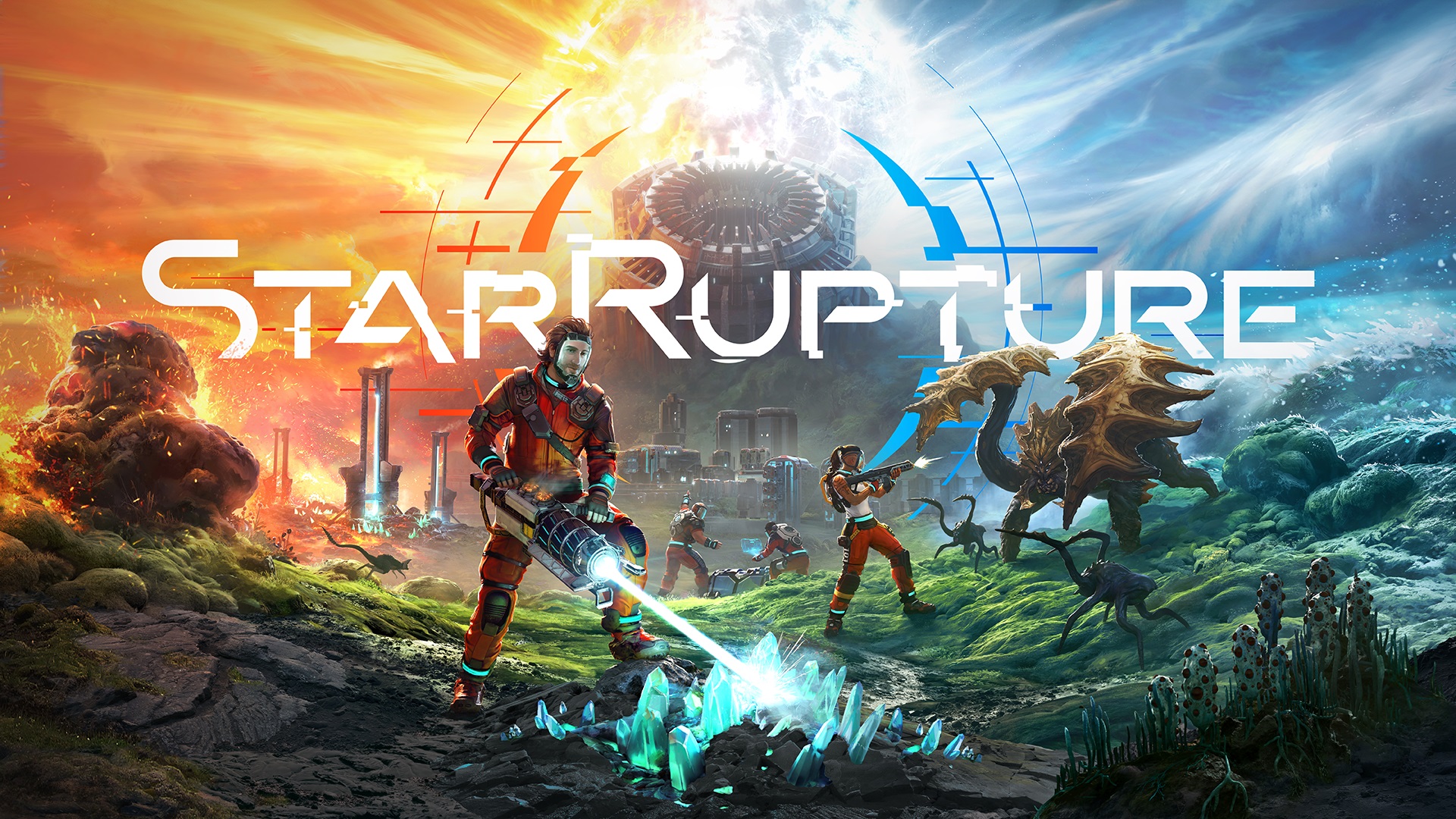
The survival and automation genres have long run in parallel. On one side, you have the grueling, stick-and-stone survival of games like Green Hell or The Forest. On the other hand, you have the industrial, conveyor-belt sprawl of Satisfactory and Factorio. Rarely do these tracks converge successfully without one mechanic overpowering the other.
Enter StarRupture. Developed by Creepy Jar—the same team that threw us into the Amazonian nightmare of Green Hell—this new title attempts to fuse high-stakes survival FPS combat with complex industrial automation. Released into Early Access on January 6, 2026, StarRupture drops players onto a volatile planet governed by a dying star.
After spending dozens of hours establishing supply lines, fighting off alien arachnids, and hiding from the apocalyptic fury of the sun, one thing is clear: StarRupture is not just “Satisfactory with guns.” It is a visually stunning, mechanically distinct beast that breathes new life into the open-world crafting genre.
The Cycle of Fire: Surviving the Rupture
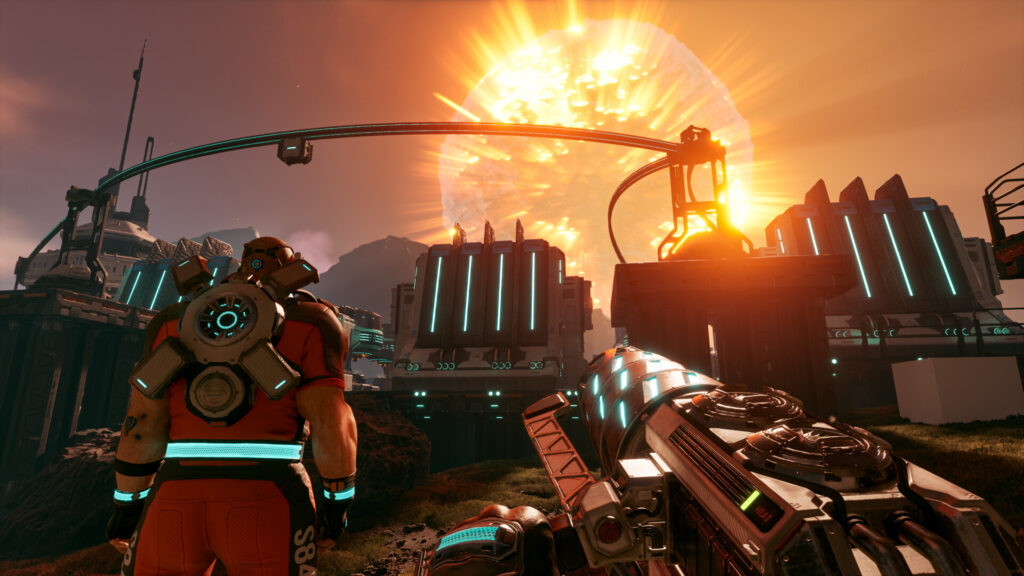
The defining feature of StarRupture, and the mechanic that dictates the rhythm of the entire game, is the titular event itself. The planet you inhabit orbits a star that is essentially exploding in slow motion. Every 50 to 60 minutes, the star erupts in a cataclysmic event known as the “Rupture.”
In most survival games, the environment is a passive stage. Here, it is an active antagonist. When the countdown hits zero, the sky turns a terrifying, blinding orange. Fire waves sweep across the surface, temperatures skyrocket, and staying outside without heavy protection is a death sentence.
This mechanic creates a fascinating gameplay loop. The Rupture forces you indoors, turning your factory into a bunker. But it’s not just a time-out; it’s an opportunity. Extreme heat evaporates water bodies, exposing caves and low-lying areas that are usually submerged. Unique resources, like “fireballs” that grant massive science points, only spawn during these hellish windows. Furthermore, the planet’s biology reacts to the cycle—plants wither and regrow in real-time, and dangerous fauna retreat, allowing brave (or foolish) players to explore high-danger POIs while the monsters are hiding.
It transforms the game from a linear builder into a rhythmic dance between expansion and survival. You aren’t just building against the resource cost; you are building against the clock.
Logistics Evolved: The Push-Pull Rail System
Veterans of the factory genre are intimately familiar with “spaghetti”—the chaotic, unmanageable mess of conveyor belts that inevitably plagues late-game builds. StarRupture takes a bold step away from this tradition by introducing a logistics system based on rails and drones.
Instead of belts that blindly push items forward until they clog, StarRupture utilizes a “push-pull” mechanism. Resources don’t move unless they are requested. You lay down holographic rails, and floating drones zip along them, carrying cargo like blood cells in a vein.
This system is arguably more intuitive and scalable than standard belts. It eliminates the frustration of items piling up where they aren’t needed. While it takes some getting used to—especially for players hard-wired for Factorio logic—watching a synchronized train of drones ferry goods across a canyon is incredibly satisfying. It feels futuristic and clean, fitting the sci-fi aesthetic perfectly.
However, it is here that the Early Access “jank” makes its presence felt. Players have reported bugs in which drones inexplicably hop between adjacent parallel rails, disrupting carefully laid efficiency. While the system is innovative, it currently requires some patience to troubleshoot when the AI takes a shortcut you didn’t authorize.
Combat and Exploration: More Than Just Turrets
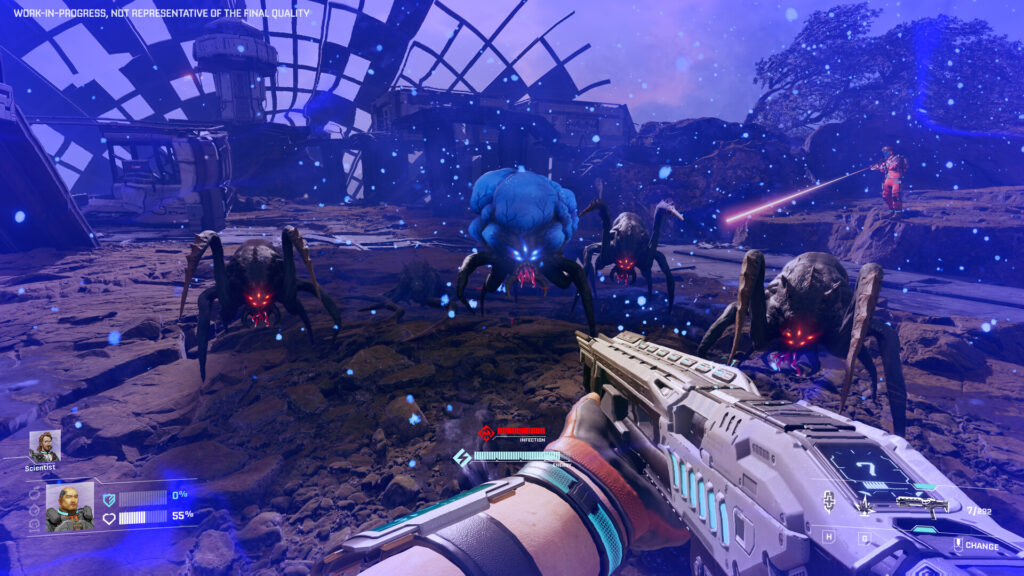
Unlike Satisfactory, where combat is largely an afterthought, StarRupture puts a gun in your hand and expects you to use it. The game is a fully-fledged FPS movement shooter disguised as a factory builder. You have a double-jump, a dash/slide mechanic, and an arsenal that feels punchy and responsive.
The weapons range from standard pistols and assault rifles to heavy machine guns. You aren’t just building walls to keep enemies out; you are actively patrolling your perimeter. The enemies—various castes of insectoid aliens—are aggressive and plentiful. They don’t just stand there; they swarm.
Exploration is heavily rewarded. The map is handcrafted and vast, filled with Points of Interest (POIs), crashed drones, and lore data. There is a mystery here involving “The Corporation” and previous failed expeditions, delivered through banter between characters that actually have personality. The dialogue can be genuinely funny, adding a layer of narrative charm that many dry simulation games lack.
Visuals: A Next-Gen Factory
It is no exaggeration to say that StarRupture is currently the best-looking factory game on the market. Powered by Unreal Engine 5, the lighting and environmental effects are spectacular.
The world feels alive. When the Rupture hits, the lighting shifts dynamically from a lush sci-fi sky to a chaotic, burning inferno. You can watch plants grow in real-time as the ash settles. Ponds dry up and refill. The industrial machines have intricate animations that make the factory feel like a living, breathing organism.
Despite the high fidelity, the game is surprisingly well-optimized for an Early Access launch. Users with mid-range cards (like the RTX 3060) report stable performance, and the game is already finding a home on the Steam Deck, running well enough to be playable despite not yet having official verification.
The Early Access Roadmap: What’s Next?
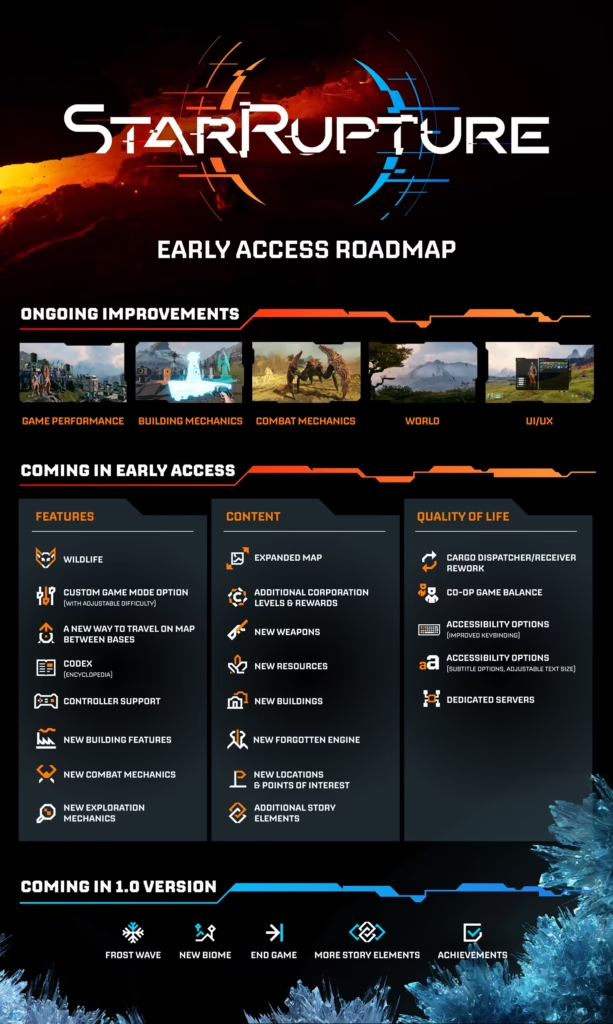
Creepy Jar has been transparent about the game’s Early Access status and has already published a robust roadmap. While the current content offers dozens of hours of gameplay (some players are already at 40+ hours within the first week), there are gaps.
According to the Early Access Roadmap, upcoming features include:
- Wildlife: Non-hostile fauna to make the world feel more like an ecosystem rather than just a battlefield.
- New Biomes: The “Frost Wave” update promises to introduce cold mechanics, likely serving as the polar opposite of the current fire-based hazards.
- Controller Support: Essential for the console and handheld crowd.
- Dedicated Servers: A must for the co-op community.
- Custom Game Modes: Adjustable difficulty settings for those who want to focus purely on building or purely on survival.
Currently, the game suffers from some collision issues—players report bouncing off steep terrain or getting stuck on geometry. The lack of defensive walls is also a sore point for players who want to turtle up. However, the developers are active, having already pushed hotfixes within days of launch.
StarRupture is a triumph of genre-blending. It successfully marries the dopamine hit of industrial expansion with the adrenaline of survival shooters. By replacing conveyor belts with drones and introducing the cyclical threat of the Star Rupture, it creates a gameplay loop that feels fresh, urgent, and rewarding.
It is rare for an Early Access title to launch with this level of polish and visual fidelity. While it has rough edges—specifically in movement physics and rail logic bugs—the foundation is rock-solid. For the introductory price of $15.99, it offers incredible value, arguably providing more content and stability on day one than many AAA titles do at launch.
If you ever looked at Satisfactory and thought, “I wish this planet were trying harder to kill me,” or looked at Green Hell and thought, “I wish I could automate this survival struggle,” StarRupture is the game you have been waiting for.
| The Good | The Bad |
| The Rupture Mechanic: A visually spectacular event that changes gameplay, exploration, and resource gathering every hour. | Rail Glitches: The innovative drone system sometimes suffers from pathfinding bugs where drones hop rails. |
| Visuals: Unreal Engine 5 delivers the best graphics in the automation genre; dynamic weather and lighting are top-tier. | Terrain Physics: Movement can feel clunky on steep slopes; players often bounce off geometry or get stuck. |
| Drone Logistics: The “push-pull” rail system is a refreshing, clean alternative to conveyor belt spaghetti. | Rail Glitches: The innovative drone system sometimes suffers from pathfinding bugs that cause drones to hop rails. |
| Combat & Movement: Punchy FPS mechanics with dash/slide movement make exploration fun and fast. | No Walls: The inability to build defensive perimeter walls is a strange omission in a base-defense game. |
| Price Point: At ~$16-$20, the amount of content and quality provided is an absolute steal. | Controller Support: Currently lacks full official controller support, though it’s on the roadmap. |
StarRupture: StarRupture is a stunning, ambitious fusion of automation and survival action. Its unique "Rupture" mechanic adds a layer of rhythmic tension that transforms the landscape and gameplay loop in exciting ways. With best-in-class visuals, a distinct drone-based logistics system, and a solid combat engine, it sets a high bar for Early Access titles. While it suffers from minor physics jank and needs more enemy variety, it is an absolute must-play for fans of the genre. – Flare