


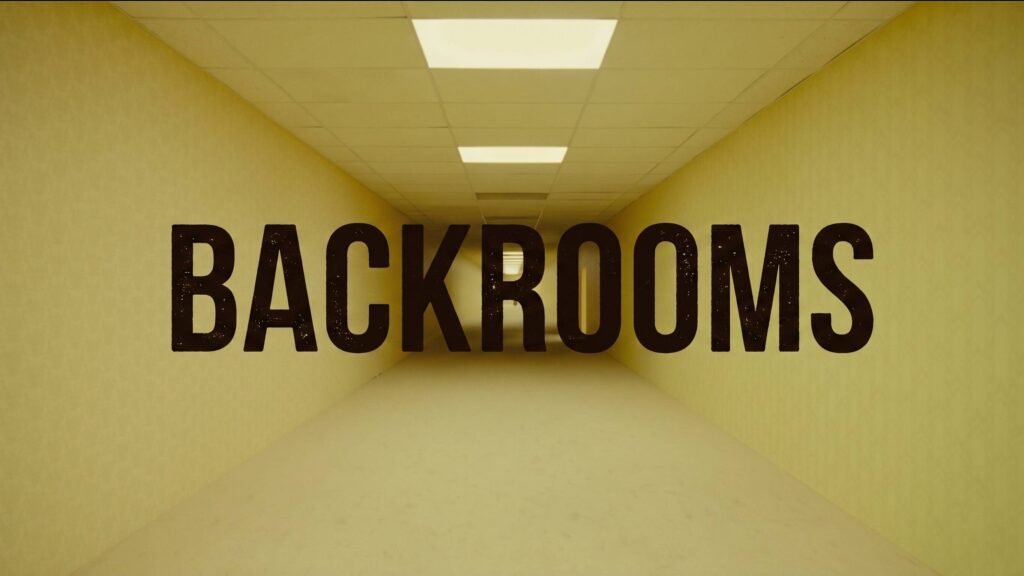
Backrooms is a remarkable debut — not perfect, but genuinely remarkable. Directed by Kane Parsons at 20 years old, based on the viral liminal space creepypasta he turned into a YouTube web series that took the internet by storm, and distributed by A24 with James Wan, Shawn Levy, and Osgood Perkins among its producers, it is both one of the most atmospheric horror films of 2026 and the rare case where a filmmaker’s creative instincts are more interesting than the script he’s been handed. The first act is exceptional. The middle section is excellent. The third act has divided audiences down the middle, and those divisions are legitimate — but the film earns serious credit for choosing the harder, more abstract ending over the commercially easier version of itself.
The setup is deceptively simple. Clark (Chiwetel Ejiofor), a discount furniture store owner in the middle of a post-divorce breakdown, discovers that his store’s basement contains a door that doesn’t exit onto anywhere that exists. He steps through and ends up in the Backrooms — an endless labyrinth of fluorescent-lit, yellow-carpeted office corridors, with buzzing lights, damp walls, and the persistent sense that something else is in there with him. When he goes missing, his therapist Dr. Mary Kline (Renate Reinsve) enters after him. The film tracks what happens to both of them as they descend further from reality.
What Parsons Gets Exactly Right
The first hour of Backrooms is as close to perfect liminal space horror as cinema has gotten. The production built roughly 30,000 square feet of practical sets, and the commitment to physicality is visible in every frame — these corridors have weight, the lighting has texture, and the yellow carpet somehow generates more dread through sheer visual monotony than any set piece could. Cinematographer Jeremy Cox shoots the Backrooms with patient, observational camera work that resists the temptation to be overtly cinematic, letting the architecture do the unnerving. Early in Clark’s exploration, something as mundane as noticing a shirt he owned sitting in a pile of clothing he doesn’t recognise manages to be one of the most skin-crawling moments in recent horror.
Ejiofor is doing real work in a role that requires him to track a long, uneven arc from sad-sack melancholic furniture store owner through awestruck explorer to something considerably darker. Reinsve, coming off her Cannes-winning work in The Worst Person in the World, is excellent as Dr. Kline — a character whose own unspoken trauma shapes what she experiences inside the Backrooms in ways the film only half-explains but which are consistently resonant. The idea that the Backrooms manifests differently depending on who enters — that the environment is drawing on memories, fears, and subconscious material — is the most interesting conceptual move the film makes, and both performances support it.

Where It Divides Audiences
The third act is where Backrooms becomes a film that will genuinely split rooms. The open-source online campfire tale centres on explorers of a windowless, acid-yellow office building that becomes a maze of transmogrifying rooms and corridors — all hallways and doors leading to nowhere that seem to feed on the existential and psychological fears of anyone who walks through them. The film leans fully into that premise’s most abstract implication: that the Backrooms aren’t a place so much as a projection, and that what you find there is shaped by what you carry in. The specific monster reveal is — depending on your relationship to the lore and your tolerance for abstract horror — either the perfect Lovecraftian execution of that concept or a disappointing concrete answer to a question that was more powerful as a mystery. Both positions are defensible.
Parsons’ choice to make Backrooms feel like a companion piece to his web series rather than a definitive explanation of it is deliberately daring. He is not adapting his own lore so much as working alongside it — expanding the emotional and psychological language of the world without claiming to answer every question. For viewers who find that approach satisfying, the ending lands with genuine unease. For viewers who wanted the monster, the answers, and the complete mythology, the film will read as deliberately frustrating. Both responses are honest.
The Good, The Bad, & The Ugly
| The Good | The Bad | The Ugly |
|---|---|---|
| The First ActAmong the finest sustained horror atmospheres in recent memory. 30,000 sq ft of practical sets, patient cinematography, and pure liminal dread executed without a single cheap scare. | The Third Act SplitThe abstract finale will lose a significant portion of the audience who came for lore completion and monster payoff. The division is real and not unreasonable. | What’s in the FurnitureYou’ll know the moment when you see it. The specific monster design is the film’s most polarising creative choice — a concept that works on paper and has a genuinely contested execution on screen. |
| Chiwetel Ejiofor and Renate ReinsveBoth deliver performances that track significantly more character depth than the script strictly requires. Reinsve in particular is doing work that elevates every scene she’s in. | Character SpecificityClark’s backstory — divorce, professional disappointment, vague personal failure — is functional but generic. The film trusts its setting to do the heavy lifting rather than investing in making Clark irreplaceable. | |
| A24 Backing the Right 20-Year-OldKane Parsons is the real deal. The restraint, the visual patience, and the understanding that the Backrooms works because of what it doesn’t show — these are not beginner’s instincts. |
The Verdict
Backrooms is the kind of horror film that will be discussed for years — not because it resolves everything cleanly, but because it doesn’t. Parsons has made a film that respects its audience enough to leave them in the discomfort of the Backrooms’ logic rather than handing them a complete map. If that frustrates you, that frustration is part of the experience. If it stays with you for days afterward as you try to build the complete picture yourself, that’s exactly what the best horror does. Either way, Kane Parsons is 20 years old and made this, which is a fact that should make a lot of older filmmakers uncomfortable in the best possible way.
For more film coverage, check out our full reviews section.