A New Breed of Rage
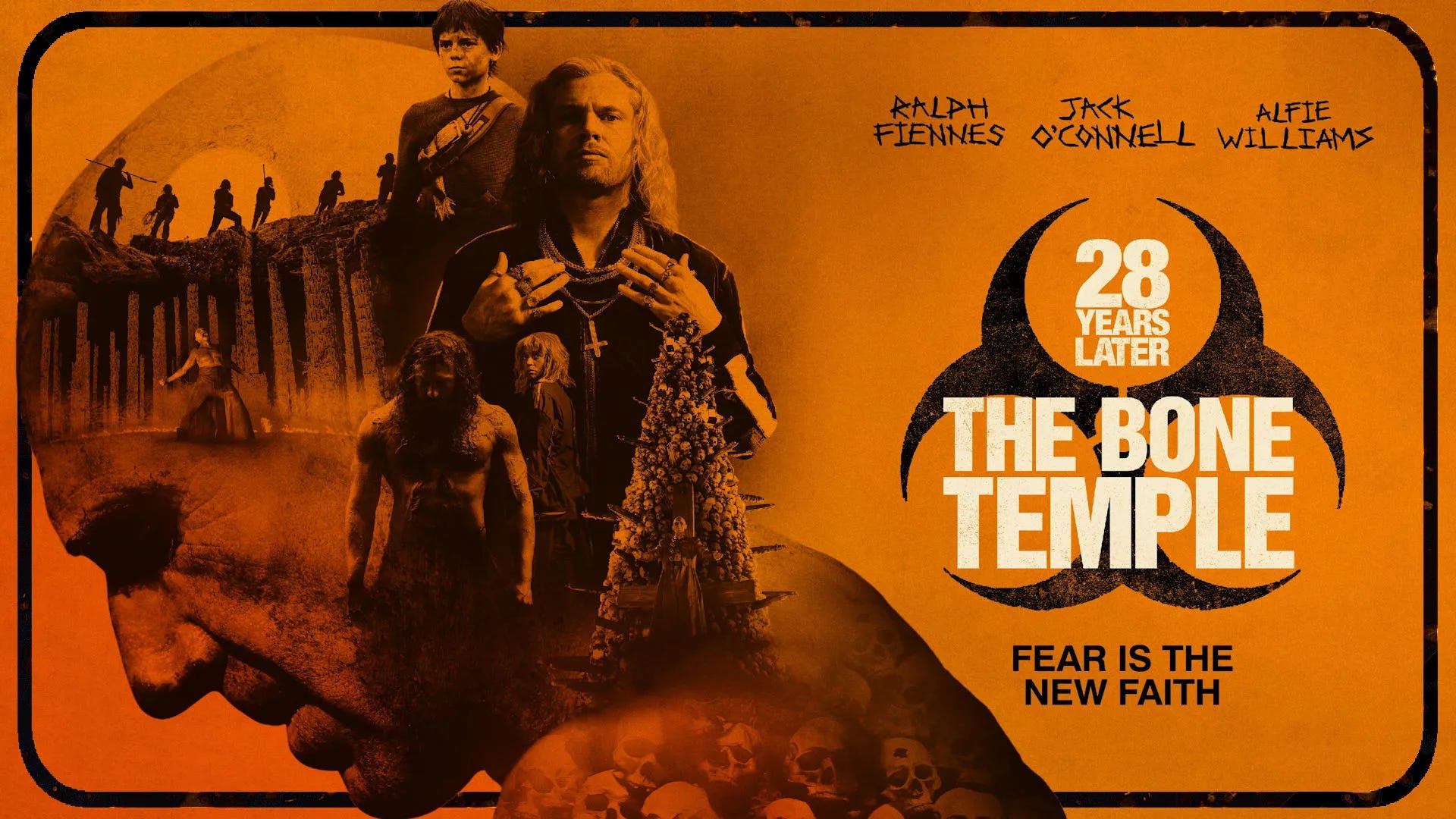
When 28 Years Later (Part 1) hit theaters, reactions were mixed. It felt like a disjointed attempt to restart a franchise that had been dormant for decades. However, its sequel, 28 Years Later: The Bone Temple, does something remarkable: it takes the most interesting threads of its predecessor and weaves them into a film that feels less like a standard zombie movie and more like a post-apocalyptic character study.
Directed by Nia DaCosta and written by Alex Garland, The Bone Temple shifts focus from mass chaos to intimate madness. It centers on Dr. Ian Kelson (Ralph Fiennes), a scientist living in isolation who conducts experiments that challenge everything we know about the Infection.
The Doctor and The Alpha
The heart of the film is the relationship between Dr. Kelson and “Samson,” an Alpha Infected he has captured. Ralph Fiennes delivers a powerhouse performance, portraying a man who has replaced fear with curiosity. Through a cocktail of homemade drugs (mostly morphine) and patience, Kelson attempts to domesticate the beast.
This dynamic is fascinating. Watching them “trip” together by the river, listening to Duran Duran while the Infected flexes its muscles in a state of chemically induced calm, is bizarre, tense, and strangely touching. It poses a question rarely asked in the genre: Is there a person still inside the monster?
The film suggests there is. The evolution of Samson from a mindless killing machine to a creature capable of looking at the moon and uttering a single word is a profound expansion of the lore. It moves the franchise away from simple survival horror into the realm of science fiction.
The Jimmies: Cult of Chaos
On the other side of the spectrum are “The Jimmies,” a cult of blonde-haired sadists introduced in the previous film. While they were a menace before, here they are fully unleashed. Led by a charismatic and unhinged leader (also named Jimmy), they worship the chaos of the new world.
Their inclusion provides the film with its most brutal horror elements. A sequence involving a farm family is genuinely hard to watch, showcasing the depths of human depravity in a lawless world. When the Jimmies eventually cross paths with Dr. Kelson—mistaking his bone temple and painted skin for the devil himself—the film reaches a fever pitch of tension.
However, the Jimmies also represent the film’s biggest flaw. Their ability to survive in a world of hyper-violent Infected using only knives and intimidation stretches credibility. In a universe established by a single drop of blood causing infection, their close-quarters combat style feels like plot armor.
Visuals and Atmosphere
Visually, The Bone Temple is stunning. The location—a remote, skeletal structure adorned with human remains—is a character in itself. The cinematography captures the beauty of the decaying world, juxtaposing lush nature with gruesome violence.
The soundtrack also deserves praise. It leans into a heavy metal aesthetic that fits the chaotic energy of the Jimmies and the operatic madness of Dr. Kelson’s experiments. The climax, featuring a literal performance by the Doctor to “prove” his divinity to the cult, is a surreal, drug-fueled nightmare that somehow works.
28 Years Later: The Bone Temple: 28 Years Later: The Bone Temple is a significant improvement over its predecessor. It is a bold, weird, and intelligent film that isn't afraid to slow down and explore the psychology of its characters. While it lacks the non-stop action of standard zombie fare, it replaces it with a creeping dread and a fascinating scientific mystery. It sets the stage for a potential third film, teasing the return of Cillian Murphy’s character from the original 28 Days Later. Whether that film happens remains to be seen, but if The Bone Temple is the end, it serves as a worthy and unique conclusion to this chapter of the Rage Virus saga. – Asmodeus
Spoiler Breakdown & Analysis
Warning: Major Spoilers Below
Let’s dissect the key revelations and the ending of The Bone Temple.
1. The “Cure” and The Evolution. The biggest revelation is that Dr. Kelson has essentially cured Samson—or at least, evolved him. By the end of the film, Samson is attacked by other zombies, but does not revert to a mindless rage monster. He has become a third thing: immune, strong, and semi-conscious. This “Zombie 2.0” concept is a game-changer for the lore.
2. The Fate of Dr. Kelson In a tragic twist, Jimmy (the cult leader) realizes Kelson is not the devil and stabs him. The Doctor is then crucified by the cult—a gruesome end for the franchise’s most compelling character. While we don’t see him die on screen (he is carried away by the loyal Samson), the severity of his wounds suggests his story is over. His legacy, however, lives on in the notebook containing his cure formula.
Shutterstock
This leads to a chaotic bloodbath where the “fingers” of the cult are picked off one by one. It’s a messy, cathartic resolution to their reign of terror.
4. The Cillian Murphy Tease. The film ends with a massive tease. We see Cillian Murphy’s character, Jim, alive and living on a farm with a daughter. He spots the survivors (Spike and Kelly) running from a horde and decides to help them. This confirms that the original protagonist is still active in this world, setting up a potential third film where the original cast meets the new generation—and perhaps uses Kelson’s notes to save the world.