
The January Dump Continues
January is often the graveyard of cinema, and following the surprisingly decent 28 Years Later: The Bone Temple, we have returned to the status quo with Mercy. Directed by Timur Bekmambetov (Wanted, Profile) and starring Chris Pratt, this film currently sits at a dismal 21% on Rotten Tomatoes.
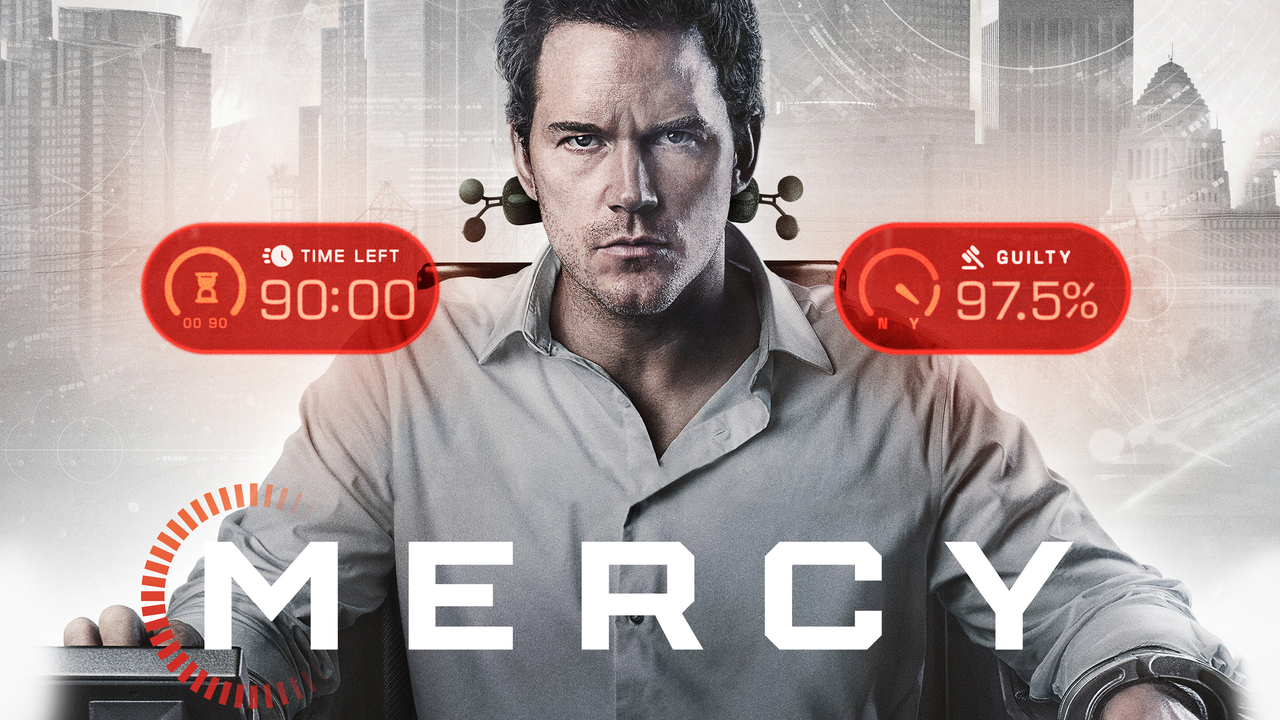
The premise is Minority Report meets Unfriended. In the near future, capital crimes are judged swiftly by an advanced AI named “Mercy” (Rebecca Ferguson). When Detective Sal (Chris Pratt) is accused of murdering his wife, he finds himself strapped to a chair, facing the very system he championed. He has 90 minutes to prove his innocence before a lethal injection is administered by the chair itself.
It sounds like a tight, tense thriller. In execution, it is a messy, contrived, yet strangely watchable train wreck that feels destined for the “$5 bin” of VOD history.
Trial by Interface
The film utilizes Bekmambetov’s signature “Screen-Life” style, though expanded beyond a simple laptop screen. Pratt spends the majority of the runtime sitting in a high-tech interrogation chair, manipulating holograms and reviewing footage to solve his wife’s murder in real-time.
For the first act, this actually works. There is a novelty to seeing a procedural drama play out entirely through UI elements and flashbacks. The ticking clock adds inherent tension. You want to see how he gets out of it. It’s a “Dad Movie” in the truest sense—something you put on while folding laundry and vaguely pay attention to.
However, the film asks you to suspend your disbelief, then to strangle it and bury it in the backyard. The murder happened mere hours ago. The crime scene hasn’t even been processed. Yet, the AI is ready to execute a decorated officer based on shaky footage? The speed of the judicial system here isn’t just futuristic; it’s nonsensical.
The Cast: Pratt in a Chair
Chris Pratt, usually known for his physical comedy and action chops, is handicapped here. He is literally strapped down for 80% of the movie. He does his best to emote “grieving husband” and “desperate cop,” but the script gives him little to work with other than shouting at a hologram.
Rebecca Ferguson plays the AI, Mercy. She is a fantastic actress, but here she is reduced to a monotone face on a screen. The film attempts to give the AI a personality arc—is she glitching? Is she developing a conscience?—but it feels unearned.
There is a brief, amusing cameo by Jay Jackson (Perd Hapley from Parks and Rec) as a reporter, which serves as a nice reunion for fans of that show, even if he’s given nothing funny to do.
The Message: confused.exe
The film seems to be in an identity crisis over its stance on Artificial Intelligence.
- Act 1: AI is dangerous. It rushes to judgment, ignores context, and strips us of our humanity. It is a warning against the surveillance state.
- Act 3: AI is awesome! We need AI to hack every camera in the city, break encryption instantly, and save the day.
By the end, the movie seems to argue that privacy invasions are actually good, provided the invader is Chris Pratt. It’s a muddled thematic mess that tries to have its cake and eat it too.
Mercy: Mercy is not the worst movie of the year (that title is still up for grabs), but it is aggressively average. It is a "content" movie—designed to fill a slot on a streaming service rather than provide a cinematic experience. If you enjoy procedural crime dramas and don't mind logic holes big enough to drive a semi-truck through, you might find a bored afternoon's worth of entertainment here. But for a theatrical experience? Save your money. This is a "wait for streaming" title if there ever was one. – Asmodeus
Spoiler Breakdown: The Logic Fails
Warning: Major Spoilers Below
If you thought the premise was silly, wait until you hear the resolution.
1. The Twist: The AA Sponsor. It turns out Pratt didn’t kill his wife. The real killer is Rob, his Alcoholics Anonymous sponsor.
- The Motive: Rob works at the same shipping company as Pratt’s wife. He has been stealing ingredients to build a massive bomb. Why? To blow up Los Angeles. Why? Because… reasons.
- The Setup: Rob befriended Pratt years ago just to frame him? The level of 4D chess required for this plan relies on so many coincidences (Pratt relapsing, Pratt attending that specific meeting, Pratt being assigned the case) that it breaks reality.
2. The “Enhance” Moment. The investigation hinges on a photo of a child found at Rob’s house. The photo is folded and blurry, showing maybe a pinky finger and an ear. Pratt yells at the AI to “Extrapolate!” and the AI magically reconstructs the child’s entire face, revealing it to be Rob’s brother (the first person ever executed by the Mercy system). It is the most egregious “Zoom and Enhance” moment in cinema history.
3. The Climax: The Unstoppable Semi-Truck Once the truth is out, Pratt (still in the chair) takes command of the entire LAPD. Rob is driving a semi-truck rigged with a bomb toward the Mercy server building.
- The Chase: The police ram the truck, shoot at it, and block the road, but the truck is apparently made of Vibranium. It doesn’t stop.
- The Jet Bike: Kali Reis’s character hops on a police “Jet Bike” (yes, a flying motorcycle) to chase the truck. It looks like a cutscene from a PS3 game.
4. The AI’s Choice The AI calculates that blowing up the truck will save the city but kill Pratt’s daughter, who is a hostage inside. Logic dictates that the needs of the many outweigh the needs of the few. However, Mercy “glitches” (grows a heart?) and decides to save the daughter, risking the lives of millions. It turns out the bomb doesn’t go off anyway, so the stakes were fake.
5. The Final Line The movie ends with Pratt and the AI reflecting on their rule-breaking victory. Mercy: “What have we done?” Pratt: “What we were programmed to do.” It’s a line meant to be cool, but it makes zero sense. Neither of them followed their programming. It’s a groaner of an ending that perfectly caps off a movie that sounded better in the pitch meeting.