


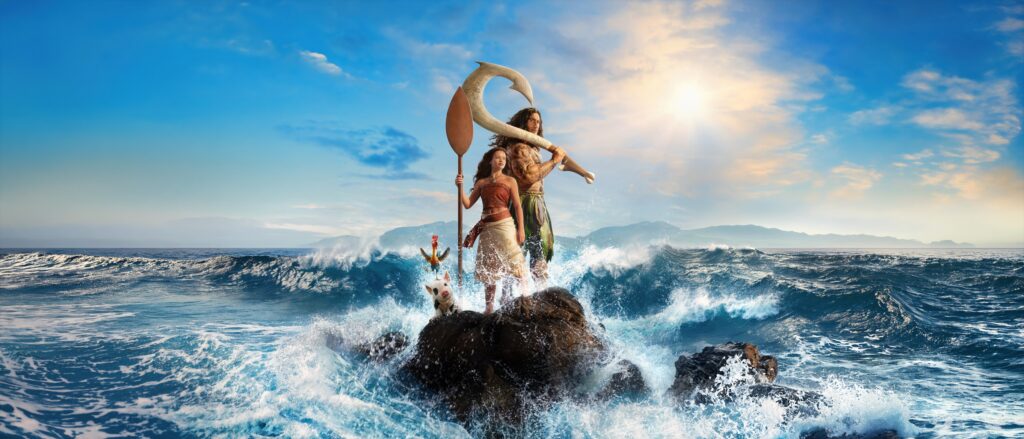
Disney’s live-action remake of Moana arrives with a 35% on Rotten Tomatoes, a 42 on Metacritic, and a 5.6 on IMDb — scores that tell a fairly clear story about how critics and audiences are receiving Thomas Kail’s adaptation. These are not scores that suggest a film unfairly treated by a hostile press. They reflect a consistent critical reaction to a live-action Disney remake that runs into the same fundamental problems the studio has been navigating across this cycle: the difficulty of translating animation’s expressive freedom into live-action without losing what made the original film work.
The 2016 animated Moana was produced by Ron Clements and John Musker, scored by Lin-Manuel Miranda and Mark Mancina, and earned an 95% on Rotten Tomatoes and a Metacritic score of 81. It was a film of genuine emotional clarity and visual invention, with songs that became genuinely beloved and a lead performance by Auli’i Cravalho that was both culturally specific and universally felt. The 2026 live-action version inherits the title, the story, and the music. Whether it inherits the film’s essential spirit is the question this review addresses.

The Cast
The Live-Action Problem
Moana the animated film works because of what animation can do that live-action fundamentally cannot — the expressive stylisation of characters, the way environments can carry emotion through colour and movement, the physical comedy of creatures like Hei Hei (the world’s least competent rooster), and the visual vocabulary of the ocean as a sentient character. When you translate that into live-action, you have two options: attempt to replicate what animation achieved through expensive visual effects (which rarely captures the original’s spirit), or reinterpret the material through a live-action lens that brings something new to justify the remake’s existence. Disney’s live-action cycle has struggled with both approaches, and the Moana remake’s scores suggest it doesn’t fully succeed with either.
The direction by Thomas Kail — best known for the Hamilton film and the Grease live television special — brings musical theatre sensibilities to the material that should serve the song-heavy source well. Whether those sensibilities translate to the scale of a Disney epic is the central directorial question the film has to answer.
What Works
Catherine Laga’aia as Moana is the film’s strongest element. The casting is right — she brings warmth, physical presence, and genuine connection to a character that needed to feel real rather than performative. Dwayne Johnson returning as Maui is a comfortable fit given his vocal performance in the original, and the live-action version of the role leans appropriately into his natural charisma rather than asking him to do something tonally unfamiliar. The music, fundamentally, is still Lin-Manuel Miranda’s music, and the songs remain among the better Disney soundtrack work of the era. When the film lets those elements breathe, it justifies itself.
Where It Struggles
The 35% Rotten Tomatoes and 42 Metacritic are both consistent with a film that’s technically competent and emotionally safe but rarely elevates beyond the requirements of the source material. The critics are not reporting that the film is offensive or disrespectful — they’re reporting that it’s unnecessary, that the visual effects don’t replicate animation’s expressive power, and that the live-action context makes certain sequences (Tamatoa, Hei Hei, the ocean’s character moments) feel less magical rather than more grounded.
The core problem that Disney’s live-action cycle has been running into is one of purpose: what does this version of the story offer that the animated film doesn’t, and that the animated film can’t be watched on Disney+ to supply? For families and younger viewers encountering the story for the first time, the live-action provides a viable alternative path to the material. For anyone who loves the 2016 film, the case for watching this over simply rewatching the original is harder to make.


The Good, The Bad, & The Ugly
| The Good | The Bad | The Ugly |
|---|---|---|
| Catherine Laga’aia as MoanaThe casting is correct. Laga’aia brings warmth and physical presence to the role, and her Pacific Islander background grounds the cultural specificity the character requires. She’s the film’s best reason to exist. | The Original Is Right ThereMoana (2016) is on Disney+ and scored 95% on RT. The live-action remake doesn’t offer enough new interpretation to distinguish itself from the original for anyone who already loves it — which is a structural problem for any remake. | The Visual Effects Can’t Replace AnimationThe ocean as a character, the creature expressiveness, the visual comedy of Hei Hei — all of these depend on animation’s stylised language. Live-action VFX approximates them rather than translating them, and the gap between approximation and the original is visible and persistent. |
| Lin-Manuel Miranda’s SongsThe music was always the animated film’s most durable element and it remains so here. The songs aren’t going to get worse by being performed by live actors — they’re too well-constructed for that — and they carry the film’s emotional beats through the sections where the direction doesn’t. | The Critical Scores Are Accurate35% RT and 42 Metacritic reflect a genuine critical consensus rather than a hostile press. The film is not unfairly reviewed. It is a technically competent, emotionally safe adaptation that fails to justify its own existence with something meaningfully new. | |
| Accessible for New AudiencesFor younger viewers or families encountering the story for the first time in 2026, the live-action provides a perfectly functional route to the material. The film isn’t failing on those terms — it’s failing on the terms of comparison to the original. |
The Verdict
Moana (2026) is a film that will entertain the audience it’s primarily made for — younger viewers and families seeing the story for the first time — and that will leave most adults who loved the 2016 animated film wondering why they didn’t just rewatch the original. Thomas Kail and Catherine Laga’aia bring genuine craft and the right casting sensibilities to the project. The music is still the music. But the scores reflect a real critical consensus: at 35% on Rotten Tomatoes and 42 on Metacritic, this is not a case of critics missing something audiences are finding. It’s a film that works as a functional product and falls short as a reason to exist.
The Disney live-action remake cycle has demonstrated repeatedly that the question isn’t whether these films can be made — it’s whether they should be, and whether each specific adaptation has a genuine artistic reason for existing beyond commercial portfolio management. Moana (2026) doesn’t clearly answer that question in its favour, and the scores are an honest reflection of that.
For more movie and TV reviews, check out our full reviews section.