
The factory automation genre has firmly established its titans over the last decade. We have the grim, insect-infested complexity of Factorio, the vertical sprawl of Satisfactory, and the interstellar logistics of Dyson Sphere Program. For fans of the genre, the loop is familiar: mine ore, smelting ingots, crafting plates, and, inevitably, drowning in a chaotic “spaghetti” of conveyor belts that would make an Italian chef weep.
But what if you took the conveyor belts away? What if the logistics were airborne, the environment was hostile, and the goal wasn’t just to build a factory, but to bring a dead world back to life?
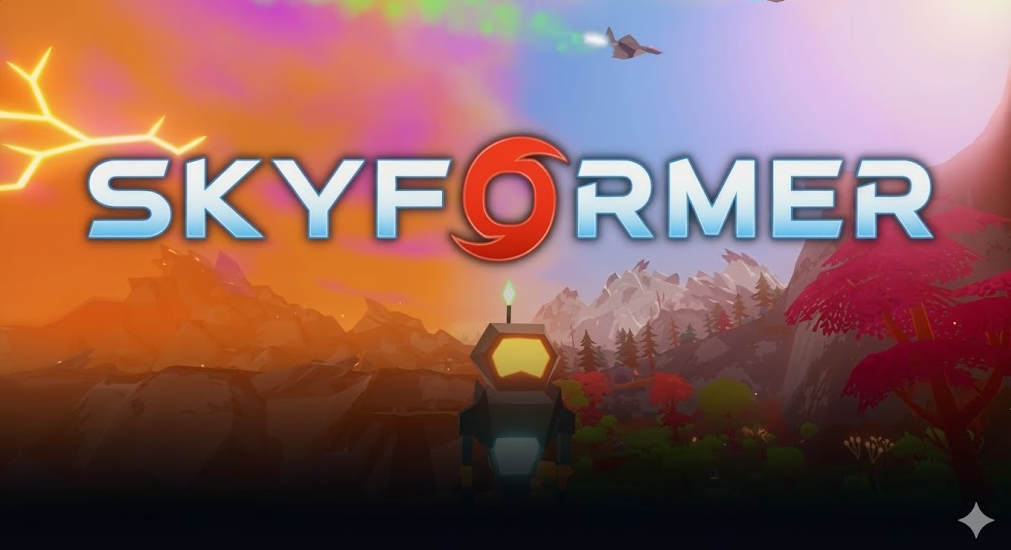
Enter Skyformer. Developed by the solo indie outfit Weatherfused and released into Early Access in November 2025, this title attempts to blend the satisfaction of automation with the environmental progression of The Planet Crafter. After sinking roughly 30 hours into its current build, I can confidently say that, while it still has the rough edges typical of Early Access, Skyformer is one of the most refreshing entries in the genre in years.
The Drone Revolution: No More Spaghetti
The immediate hook of Skyformer is its rejection of the conveyor belt. In most automation games, the primary challenge is spatial logistics—snaking a belt from Point A to Point B without clipping through five other belts. Skyformer replaces this with drones.
You play as a robot sent to prepare a planet for your creators. Your transportation and logistics rely on automated pipelines, with drones handling the heavy lifting. You configure the inputs and outputs, and a swarm of little bots buzzes back and forth, carrying resources like a colony of industrialized bees.
This shift in mechanics changes the “feel” of the game entirely. It eliminates the frustration of belt clipping and instead focuses on throughput efficiency. The game doesn’t challenge you by making you run out of resources—nodes are infinite—but it challenges you to maximize the rate at which you extract and process them. It feels less like untangling a knot and more like conducting a symphony. Watching a train of bots zip along ziplines, looking like a busy ski resort lift, is oddly hypnotic and satisfying in a way that belts never quite achieved.
Terraforming: Painting the Planet Green
While automation is the mechanic, terraforming is the motivation. The game tasks you with transforming a barren, hostile rock into a lush, habitable world. This is where the “Sky” in Skyformer comes into play.
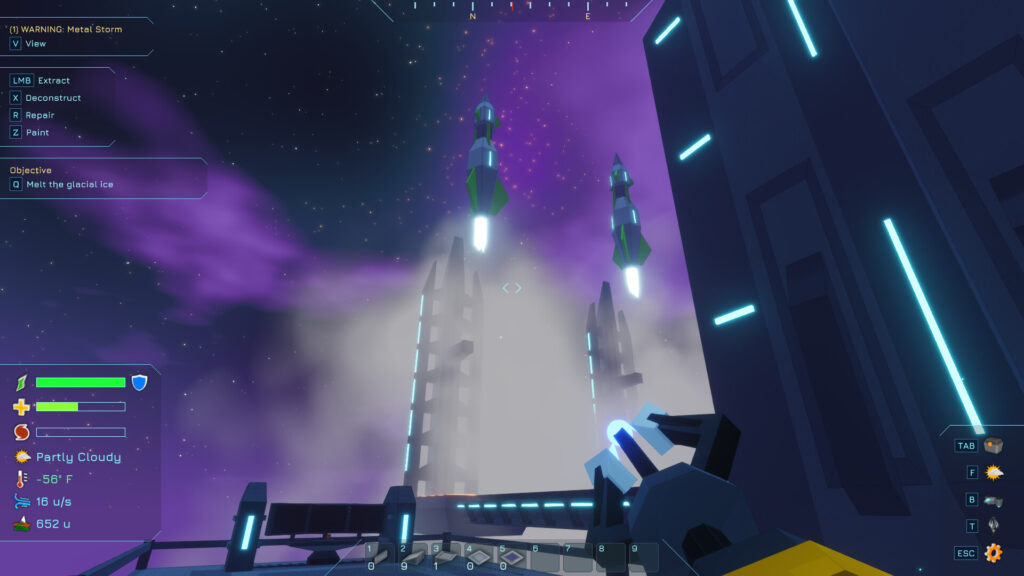
You aren’t just building a factory; you are building a weather monitoring system. The game features a dynamic weather simulation that interacts with the geography. You have to track storms, harness lightning for power, and slowly stabilize the atmosphere.
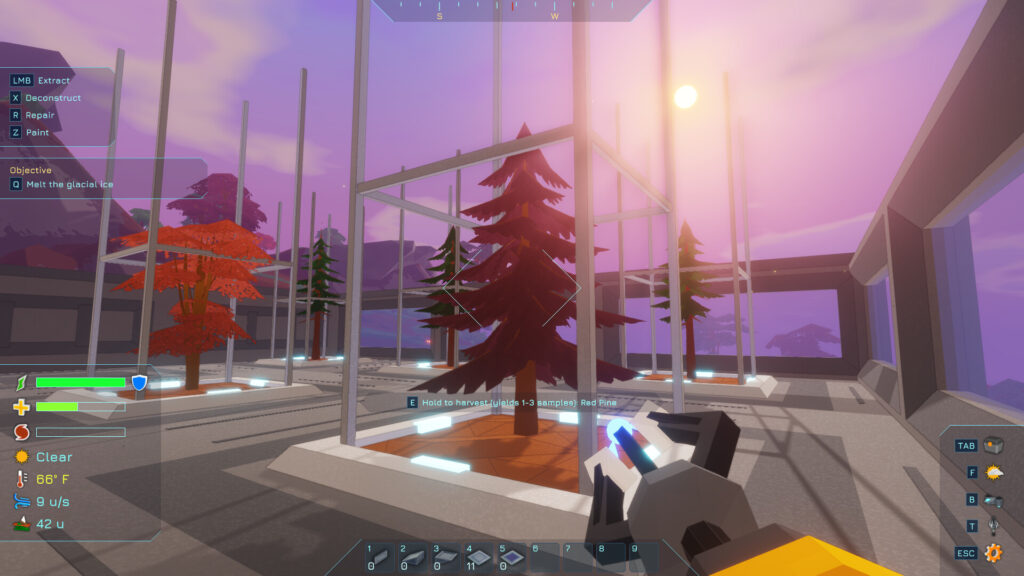
The visual progression is striking. You start in a world of red dust and jagged rocks, feeling very much like Mars. As you progress through the tech tree—stabilizing the climate, planting seeds, and managing biomass—the world changes around you. Grass spreads, trees sprout, and the sky shifts from an oppressive haze to a vibrant blue.
It is a slow burn, but seeing your factory slowly consumed by the nature you created is a unique reward loop. It adds a layer of “cozy” to the industrial expansion. You aren’t paving over paradise; you are building it.
The “Hours Per Megabyte” Champion
From a technical standpoint, Skyformer is a marvel of optimization. In an era where AAA games demand 150GB of SSD space and a GPU that costs as much as a used car, Skyformer asks for a measly 500MB.
Yes, half a gigabyte.
Despite the small footprint, the game looks great. The art style leans into a low-poly, cel-shaded aesthetic that some users have described as a “Neon Paradise.” It’s reminiscent of Tron meets Journey. The lighting effects, particularly during sunrises and electrical storms, are fantastic.
This optimization means the game runs on practically anything. I spent a significant portion of my review time on the Steam Deck, which is marked as Playable (and honestly feels Verified). It sips battery and maintains a steady framerate even when your drone swarms reach the hundreds. As one Steam reviewer, Gnarler, perfectly put it: “Everyone likes to talk about ‘hours per dollar,’ but how about ‘hours per megabyte’?”
The Early Access Roughness
However, Skyformer is still an Early Access title, and it shows. The foundation is rock solid, but the house needs furnishing.
The most common complaint—and one I share—is the UI and ergonomics. The game requires far too many clicks to perform simple actions. Setting up a new production line can feel like a battle against the menu system rather than the game mechanics. It lacks the snappy, intuitive hotkeys that Factorio veterans are used to.
Additionally, the depth of content isn’t quite there yet for the hardcore crowd. While you can easily get 25-50 hours out of the current map, there isn’t the infinite complexity or endgame scaling found in its competitors. Once you reach the current tier cap, you have largely seen what the game has to offer.
There are also some logic gaps in the physics. For a game about terraforming, the lack of a shovel or terrain deformation tool feels odd. You have to build around mountains rather than through them. Furthermore, a persistent bug (or oversight) allows storms to rain inside your factory buildings, which breaks immersion when you’ve spent hours building a roof to protect your delicate machinery.
Survival of the Storms
The survival elements are light but engaging. You aren’t managing hunger or thirst, but you are managing your battery charge and the structural integrity of your base against the weather.
Storms are not just visual effects; they are threats. Early on, a bad storm can wreak havoc on your drone lines. You have to set up monitoring stations to predict them and deploy defenses. It adds a layer of urgency to the otherwise relaxing gameplay loop. However, the game could do a better job of forecasting the consequences of your terraforming. Some players have noted that stabilizing the atmosphere too quickly can actually destroy high-altitude bases without warning, a punishing mechanic that needs better telegraphing.
The Future of the Sky
The developer, Weatherfused, has been extremely active since the November launch. The roadmap includes co-op multiplayer (currently in testing), new maps, and expanded base-building features. The game is a passion project by a solo developer, and the love poured into the engine and art is evident.
The community feedback loop is strong, with the developer regularly responding to reviews and forum posts. This level of engagement is often the deciding factor in whether an Early Access game survives or dies, and Skyformer seems to be in good hands.
Skyformer is a game of massive potential. It successfully carves out its own niche in the crowded automation genre by ditching belts in favor of drones and focusing on environmental restoration over industrial exploitation.
It is accessible, beautiful, and runs on a potato. While it currently suffers from some UI clunkiness and a lack of endgame depth, the core loop of watching a dead planet turn green while your robot army buzzes overhead is undeniably captivating. If you are burned out on the complexity of Factorio or just want a chill, sci-fi builder to play on your Steam Deck, this is an easy recommendation.
| The Good | The Bad |
| Drone Logistics: A fresh take on automation that eliminates conveyor belt frustration. | Content Depth: Currently lacks the depth of the endgame of genre titans like Factorio. |
| Terraforming Visuals: Watching the planet transform from barren rock to lush paradise is incredibly rewarding. | Storm Mechanics: Weather effects, clipping through indoor bases, breaks immersion. |
| Optimization: incredible performance; runs perfectly on Steam Deck and older hardware (only 500MB!). | Storm Mechanics: Weather effects clipping through indoor bases breaks immersion. |
| Dynamic Weather: The storm and climate systems add a unique layer of strategy and survival. | Manual Crafting: The early game relies too heavily on slow, manual crafting before automation kicks in. |
| Developer Support: Active solo dev who listens to feedback and updates frequently. | No Terrain Tools: The inability to flatten ground or dig tunnels can be frustrating for base layout. |
Skyformer: Skyformer is a charming, innovative entry into the automation genre that trades grim industrialism for hopeful terraforming. Its unique drone-based logistics system cures the headache of "spaghetti belts," and its optimization is a technical marvel. While it suffers from Early Access growing pains—specifically regarding UI ergonomics and content depth—it provides a satisfying 30+ hour loop that is well worth the entry price. – Obsidian