
Shelve the Potions! is a cozy first-person organization puzzle game from solo-ish self-publishing outfit Knight Owl Games, and it arrived on August 24 into a genre that has been getting very crowded very quickly. Sorting games are everywhere right now. This is the best-argued one we’ve played.
The setup is disposable and charming: you’re a witch’s brand new apprentice, the witch is away, and her cats have knocked over roughly two thousand potions. Put them back. That’s the whole premise, and the game is smart enough not to over-explain it.
The Puzzles Are Actually Puzzles
Our verdict: a delightfully cozy puzzle game that turns potion organization into genuine brain-teasing fun with its clever symbol system and charming witch aesthetic. The emphasis belongs on genuine.
The core loop is discovery rather than execution. You approach a shelf, look at what’s there, and try to work out what governs the order. The ordering keys vary — symbols, sizes, colours, numbers, cryptic notes left around the cellar — and once you crack one, slotting the bottles in is the satisfying part rather than the work. One player described it as determining the order through small puzzles “instead of just numbers, which prompts a little more exploration than just running around grabbing items,” and that’s exactly the distinction.
Look at what’s already placed and what the labels are doing. Some rules are visible immediately.
Others need a note, an item, or something learned elsewhere in the workshop entirely.
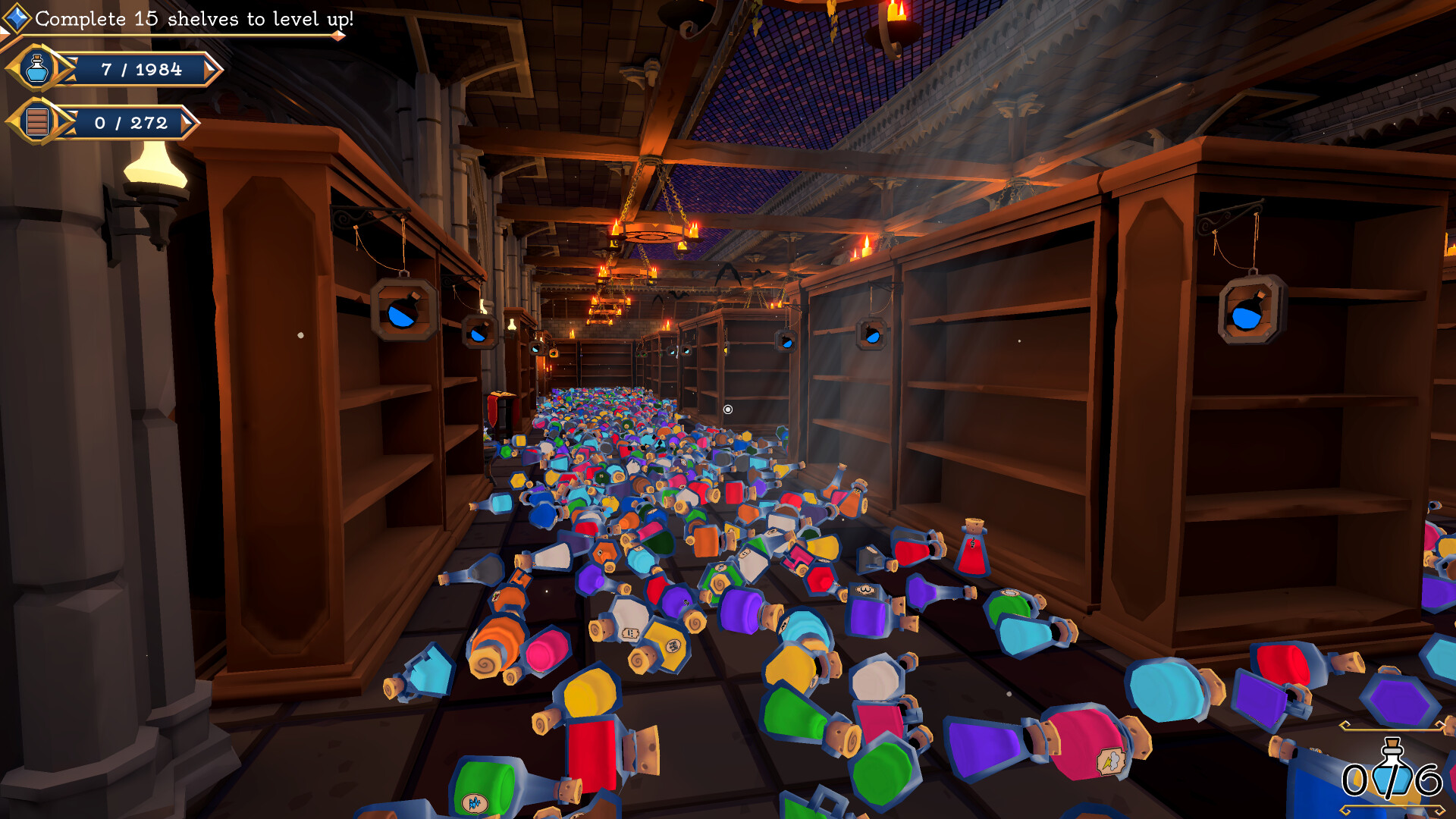
Potions are scattered across the floor — bright, distinct, and easy to spot from a distance.
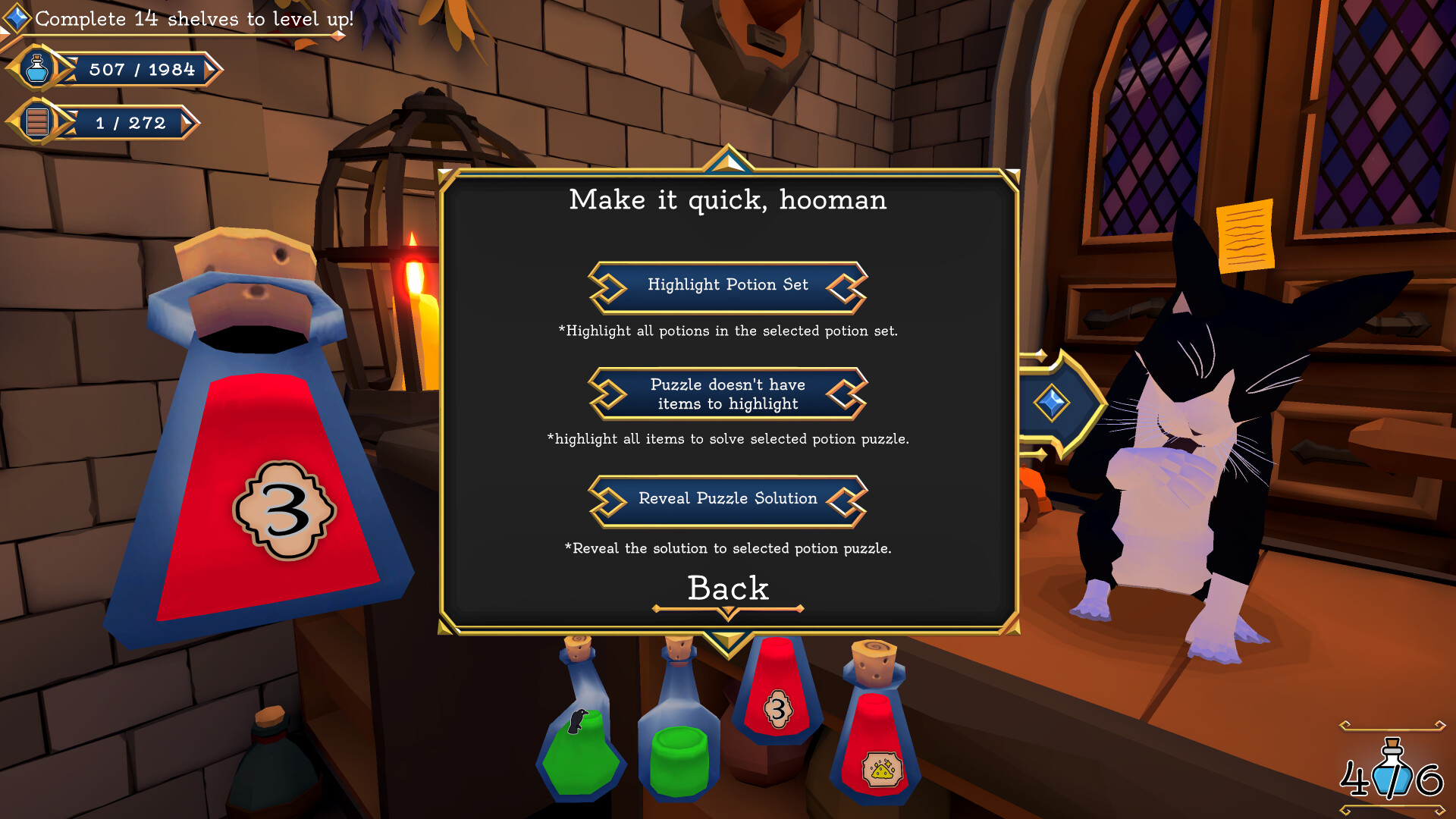
Stuck? Pet one, ask for a hint, get pointed at what you’re missing. Entirely optional.
Accessibility Is a Design Pillar, Not a Menu Toggle
This matters more than it sounds. The single most common failure in sorting games is items that look too similar to differentiate, which turns a puzzle into an eye test. Knight Owl Games appear to have treated legibility as a first-order design problem rather than an afterthought, and the whole game is more relaxing for it.
The AI Question
We’d note this isn’t a moral gold star so much as a practical one. Hand-designed potions are easier to tell apart than generated ones, which makes the puzzles better. The ethics and the craft are pointing in the same direction here.
Magic, Optional
There are no timers and no penalties either. Nothing in Shelve the Potions! is trying to create pressure, which is the correct call for a game whose whole appeal is that it’s soothing. One player put ten hours into it and described it as legitimately calming for their brain, then considered starting over for the last achievement.
Where It Runs Thin
The criticism is consistent enough across players that it’s clearly real: it gets repetitive. Once you’ve cracked several sections, the discovery element — the best part — starts to run out, and what’s left is the execution. As one player put it, after you crack the code it becomes “mechanical entertainment.”
The related complaint is that some individual puzzles resolve too simply, and that there isn’t enough variety between shelves. Both are fair. The game is at its strongest in the middle stretch, when you’ve learned enough of its vocabulary to enjoy the deductions but haven’t yet seen most of its tricks.
To be balanced about it: this is a $5.99 game that runs about ten hours, and “I wish there were more of the good idea” is a considerably better problem than most games in this price bracket have. It’s also a debut-scale release from a small team, and more variety is exactly the sort of thing a content update can add.
Things to Know Going In

The Good, The Bad, & The Ugly
| The Good | The Bad | The Ugly |
|---|---|---|
| Every Shelf Has Its Own RuleTwenty-plus handcrafted puzzles where working out the ordering principle is the puzzle. Symbols, sizes, cryptic notes and clues hidden elsewhere in the workshop, rather than one number-sorting idea repeated twenty times. This is the whole reason to buy it. | Repetition Sets InOnce you’ve cracked several sections the discovery runs dry and you’re left executing. Multiple players landed on the same word — “mechanical” — for the back half. | Some Solutions Are Too SimpleA few shelves resolve almost immediately, which undercuts the deduction the rest of the game is built on. More elaborate puzzles were the most requested thing across player feedback. |
| Genuinely Accessible DesignOrder is carried by numbers, size, symbols and colour rather than small text. Potions are distinct and easy to spot. There’s a zoom. Solved shelves are stored in the menu so you’re not re-walking the cellar. Legibility was clearly a first-order design goal. | Not Enough Variety Between ShelvesThe individual rules are clever, but the shape of the puzzles doesn’t change enough across the workshop. The vocabulary is smaller than the first few hours suggest. | Roughly Ten HoursFair for $5.99 and nobody’s complaining about value — but if you were hoping for a long-haul cozy game to live in, this isn’t that. Players are finishing it in a day or two. |
| The Cats Are the Hint SystemPet a cat, ask for help, get pointed at a missing potion or a clue you walked past. Optional, well-judged, and it makes asking for help feel like a treat rather than an admission. Also: all of them are pettable. | You’ll Probably Look One UpSeveral players hit a solution or two they couldn’t crack and went to a guide. Not a dealbreaker, but the difficulty curve isn’t perfectly smooth. | Small Review SampleVery Positive at 91%, but that’s across 70 reviews on a game released 24 August. The consensus is consistent — there just isn’t much of it yet. |
| Hand-Made Art, and It ShowsThe devs stated no generative AI was used and published behind-the-scenes material to back it up. The practical benefit is real: deliberately designed potions are easier to tell apart, which makes the puzzles better. | No Timers, No Pressure — By DesignListed here only as a fit warning. If you want a sorting game with scoring or challenge modes, this deliberately withholds that. | Late-Game Pacing Leans on PowersThe unlockable abilities smooth out the back half, which is welcome — but it does suggest the later sections were built knowing you’d have them. |
The Verdict
Organization games arrived fast and multiplied faster, and a lot of them are the same idea with different assets. Shelve the Potions! is the one that actually did something with the format. Making each shelf a small deduction rather than a data-entry task turns sorting into puzzling, and the difference between those two verbs is the entire review.
What pushes it further is the care around the edges. The legibility work that makes it playable for people other sorting games have shut out. The cats functioning as a hint system that’s a pleasure to use. Abilities that are optional because the base pacing was tuned properly. Art made by hand, which is both an ethical position and — more relevantly here — a functional one, because distinct potions make better puzzles.
It does thin out. The last stretch is more execution than discovery, some shelves fold too easily, and there isn’t quite enough variation between them. Every player who raised those points also recommended the game, which tells you roughly how much weight to put on them.
The honest read: if you like sorting games at all, buy this one — at $5.99 it’s the easiest recommendation in the genre right now. If you’ve been avoiding the category because the art all looks the same and you’re not sure how it was made, this is the entry that answers both objections. And if you’re on the fence, there’s a free demo.
Ten hours, six dollars, twenty-odd genuinely clever puzzles and a workshop full of cats you can pet. That’s a good deal.
For more game reviews, check out our full reviews section.