
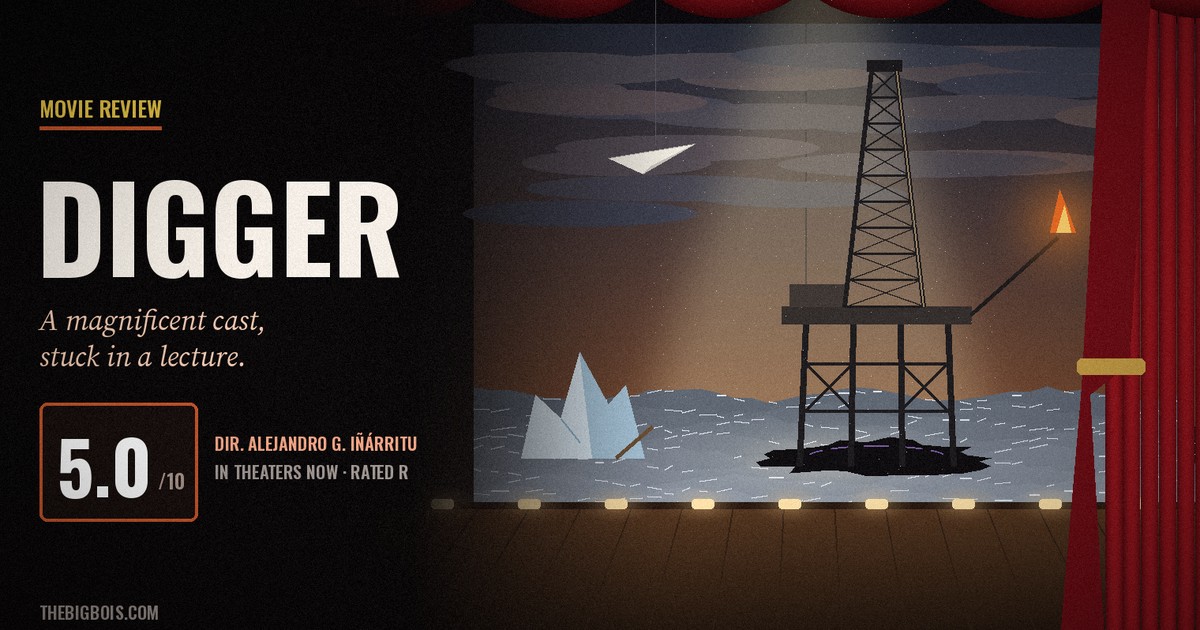
After unleashing a disaster that threatens to destroy everything, oil magnate Digger Rockwell, the most powerful man in the world, sets out on a frantic mission to prove he’s actually humanity’s saviour. Picture a drilling disaster of world-changing proportions, a White House that can’t stop panicking, and one billionaire who is very, very good at controlling the story.
Directed by Alejandro G. Iñárritu (Birdman, The Revenant) and shot in VistaVision by his longtime cinematographer Emmanuel Lubezki, it stars Tom Cruise, who also produces, alongside Riz Ahmed, John Goodman, Sandra Hüller, Michael Stuhlbarg and Jesse Plemons. Our verdict: a gorgeous, superbly acted big swing that’s far more exhausting than it is funny. Admire it, but you can wait for streaming.
Tom Cruise Disappears Into Digger
Whatever you think of the movie, it’s impossible to deny that Cruise goes all in. Under layers of prosthetics and makeup as an older, heavier oil baron, he’s almost unrecognisable, and he’s easily the most interesting thing on screen. We’ve seen him play against type before, most memorably in Tropic Thunder, but this is a full transformation and a reminder that the action star can still surprise you.
Digger is a monster, but a charming one, and Cruise sells the character’s real superpower: he can talk anyone into anything. It’s a loud, committed, occasionally unhinged performance, and it’s the clearest reason to see the film.
An Ensemble Worth the Ticket on Its Own
Digger Rockwell, the oil baron who broke the world and wants the credit for fixing it.
Dr. Nirav Ganesh, Digger’s head of Environmental Safety and the film’s frazzled conscience.
President Compson, a commander-in-chief way out of his depth.
Emma Rockwell, a member of Digger’s family.
Eddie, the Vice President.
Kenny Rockwell, in a brief but memorable turn.
Lubezki, Miniatures and Paper Planes
This is also a terrific-looking film. Lubezki’s camera is restless and inventive, and the production design is full of surprises, from opulent sets to playful, handmade miniatures. One of its cleverest tricks is cutting from huge, expensive-looking CGI military spectacle straight to models and paper planes, which is both funny and genuinely striking.
There’s a chaotic, hectic energy to it all that keeps you watching even when the story doesn’t. One reviewer described it as a train wreck you can’t look away from, which is about right. And a special mention for the film’s robotic cat: one reviewer wanted to personally thank whoever built it.

Where It Falls Apart
The trouble is everything holding those performances together. Without spoiling it, Digger has a theatrical, meta layer to how its story is told, and it’s the make-or-break element. If it works for you, it’s a bold piece of filmmaking. If it doesn’t, it can feel like a room full of theatre kids applauding themselves.
Theatres or Streaming?
See It in Theatres If…
- You love art-house risks like Birdman, Beau Is Afraid or Eddington
- You want to see Tom Cruise do something completely different
- Cinematography and production design are reasons enough for you
- You enjoy theatrical, meta storytelling
Wait for Streaming If…
- You’re expecting a Tom Cruise blockbuster
- Rapid, overlapping dialogue drives you up the wall
- You want a satire that’s actually laugh-out-loud funny
- Long, talky films test your patience
⚠️ Spoilers: the twist explained (click to reveal)
Inside the play, a drilling disaster breaks off a vast chunk of ice nicknamed “Judy” that slams into Norway, and the US government’s response escalates absurdly from there. Backstage, Curtis is told mid-performance that his daughter’s plane is missing in a storm, and has to keep going. A fan who keeps visiting him turns out to have a personal link to the real Rockwell family. The play ends with Digger leaping from his rig into the foil ocean, and the audience then heads out, masked, into a flooded, militarised world.
For us, it’s a clever framing on paper, but it adds a layer of self-congratulation rather than real insight, and the daughter storyline is little more than manufactured tension.
Things to Know
The Good, The Bad, & The Ugly
| The Good | The Bad | The Ugly |
|---|---|---|
| A Transformative CruiseUnrecognisable under prosthetics, and the most compelling thing on screen. | Satire Without BiteIt tells you what you already believe, with few real laughs. | A Box-Office DisasterVariety reports a possible $245M loss after a 60% second-weekend drop. |
| John Goodman’s Big SceneAn unhinged presidential monologue that’s the film’s high point. | Deliberately Grating DialogueFast, overlapping and relentless, with an off-putting score to match. | Self-Congratulatory FramingIts meta, theatrical layer will thrill some and infuriate others. |
| Stunning CraftLubezki’s camera, inventive sets, and miniatures and paper planes cut against huge CGI. | Feels Far Longer Than 2h 9mOne speech after another wears you down. | — |
| The Plane SceneA sharp lesson in how stories beat facts, and the satire at its best. | Dead-End SubplotsThe daughter storyline and a predictable reveal both fall flat. | — |
The Verdict
Digger is exactly the kind of film people say Hollywood doesn’t make anymore: a huge-budget, star-driven experiment from an Oscar-winning director with something on its mind. It’s beautifully shot, the cast is phenomenal, and Tom Cruise delivers one of the strangest, most committed performances of his career.
But a satire has to say something new, or at least be funny, and Digger mostly does neither. Its meta structure, wall-to-wall dialogue and endless speeches turn a 2-hour-9-minute movie into an endurance test, and its message, however sincere, never goes beyond what its audience already believes.
The honest read: admire the ambition, savour the performances, and catch it on streaming. If you love divisive art-house swings, though, you’ll want to see it and pick a side for yourself.
For more reviews, check out our full reviews section.