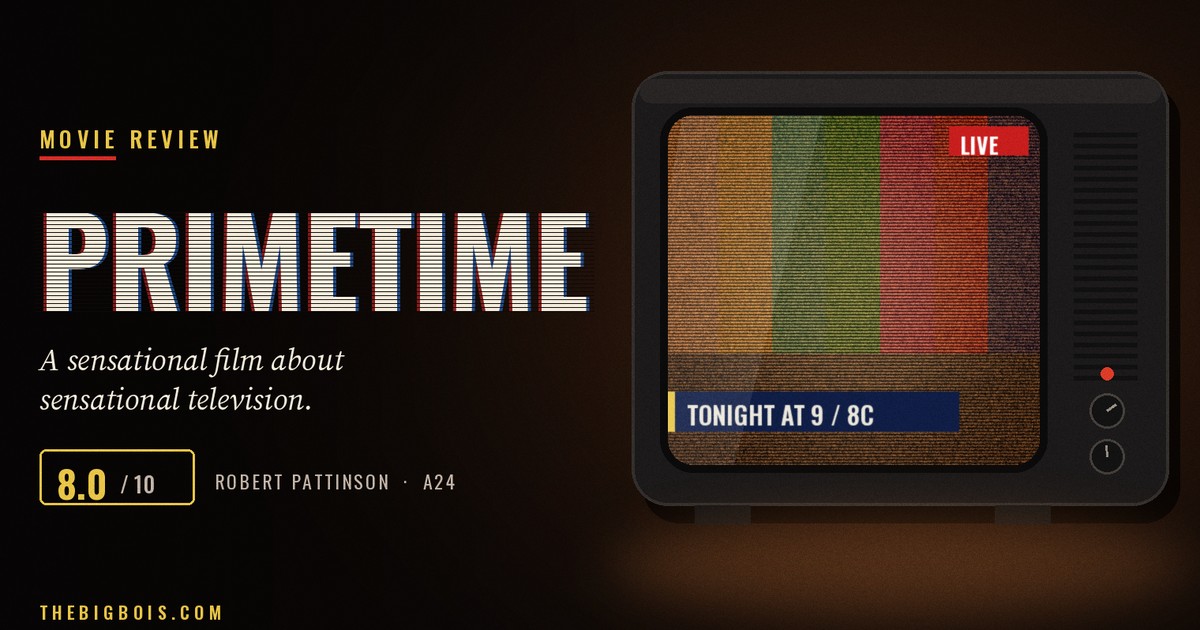
Film: Primetime
Director: Lance Oppenheim
Released: September 25, 2026 (USA)
Rating: R
Runtime: 1h 49m
Genre: Psychological Thriller / Media Satire
Studio: A24
Starring: Robert Pattinson
⚠️ Content Note
Primetime is about a real television sting operation targeting men who tried to meet minors, and about a real-life sting that ended in tragedy. Its subject matter includes child sexual exploitation and suicide. This review discusses those themes without graphic detail.
If you’re struggling, support is available — in the US, you can call or text 988 to reach the Suicide & Crisis Lifeline.
Psychological ThrillerMedia SatireDramaBased on True EventsTrue CrimePeriod Piece2000sA24Narrative DebutControversial
87%Rotten Tomatoes
79%Fandango
7.2IMDb
3.5/4RogerEbert.com
$19.2MOpening Weekend
📺 Know this first: the man Primetime is about says it isn’t true. Chris Hansen has publicly called the film a “complete work of fiction” and has not ruled out legal action against A24 — and the film’s own end credits acknowledge that much of it was invented. Go in understanding that this is a dramatisation, not a documentary.
⚖️ A Film About Sensational Television, Made as Sensational Cinema
Primetime follows Chris Hansen, host of To Catch a Predator, in 2006 — as he sets out to make television history with an undercover operation that became one of the decade’s most controversial cultural phenomena.
The most useful way to understand the film — and the fierce argument around it — comes from a phrase one reviewer used: it’s a sensational product about a sensational product.
Primetime is interested in how the show was made: the network, the ratings race, the behind-the-scenes decisions, the cost to the people pulled into the sting. And it tells that story with every tool of heightened cinema — a warm, grainy mid-2000s television look, dreamlike horror sequences, a dominant score, and a mesmerising central performance.
That’s exactly why it divides people. To its admirers, it’s a sharp critique of exploitative television. To its critics — including the real Chris Hansen — it’s guilty of the very sensationalism it examines, and takes liberties with real events and a real person to do it. Both readings are worth taking seriously.
Television history — at what cost?
Primetime is the narrative feature debut of director Lance Oppenheim, released by A24 on September 25. Produced by Robert Pattinson and Ari Aster among others, and based on a 2007 Esquire article, it stars Robert Pattinson as Chris Hansen, alongside Merritt Wever, Phoebe Bridgers, Skyler Gisondo, Anna Faris, Bokeem Woodbine and Jonathan Lipnicki.
It’s been a critical and commercial success — 87% on Rotten Tomatoes, and a reported $19.2 million opening weekend driven by a strong Gen Z turnout — and one of the most argued-about films of the year.
Our verdict: a gripping, superbly performed and ambitious film that will leave you unsettled — though not always for the reasons it intends.
Robert Pattinson Is Extraordinary
🎭 The Performance at the Centre
Whatever you think of the film, Robert Pattinson is magnetic in it. Reviewers describe being transfixed by his work from beginning to end, and some are already talking about an Oscar nomination.
A big part of it is the voice. Pattinson has a track record of transforming his voice, and his take on Hansen’s distinctive delivery is uncanny. It’s a performance that makes you understand why the show was so compelling to watch — which is precisely what makes the film’s questions about it uncomfortable.
The supporting cast is strong across the board, with Merritt Wever singled out as a standout.
Directed Like a Horror Film
Oppenheim, until now best known for documentaries, brings a bold visual style. The image is pushed extremely warm, with added grain and noise to make it feel like mid-2000s broadcast television. The score is a standout, at times becoming almost a character in its own right.
The most striking choice is a series of surreal, dreamlike sequences that play like a horror film, depicting Hansen’s memories of what first drew him toward this work — at times imagining the threat almost as a literal monster. RogerEbert.com’s Matt Zoller Seitz described the film as a media satire, a thriller and a horror movie at once, preoccupied with what the word “evil” really means.
It’s also attentive to the people around the stings. Some viewers have singled out its portrayal of a young decoy who is visibly traumatised by what he’s thrown into — and later unsettled again by seeing his own fear broadcast on television.
The Real Chris Hansen Has Spoken
📣 “A Complete Work of Fiction”
It’s impossible to review Primetime without acknowledging that its subject strongly objects to it.
Chris Hansen has called the film a “complete work of fiction”, saying that beyond the use of his name and a few catchphrases, everything else is fictionalised. He’s described it as bizarre and detached from reality, called it an insult, and gave Pattinson’s performance a “D.” In interviews, he has said he felt exploited, and has not ruled out legal action against A24. He has also been clear that he doesn’t regret the work the show did.
For his part, Pattinson has said publicly that he hopes Hansen will like the film — and that, if not, he can at least appreciate the effort that went into it. And the film itself includes an end-credits acknowledgement that much of what you’ve seen was invented for dramatic purposes.
Our view: that disclaimer matters. Primetime is a dramatisation that uses a real person’s name and a real event, and audiences should treat its portrayal of Hansen as interpretation rather than history.
Where It Falls Short
⚖️ The Fair Criticisms
1. It could handle its subject with more care. Even reviewers who loved it wished it explored such a sensitive subject with more grace. Its focus is overwhelmingly on the television machine — the network, the ratings, the competition with other primetime shows — and it leaves you wanting a deeper look at the realities the show claimed to expose.
2. Style over substance, at times. Some viewers found it maximalist but ultimately superficial: striking lighting and editing in service of showcasing events rather than saying something new about them. Others noted it struggles with tonal consistency.
3. The sympathy question. One of the loudest criticisms online is that the film invites too much sympathy for the men caught in the stings. Its defenders argue it’s critiquing the spectacle, not excusing anyone. It’s a genuine fault line, and your reaction will depend on which reading you find more convincing.
Things to Know
📋 Before You Watch
• Rated R, 1 hour 49 minutes
• A dramatisation — the film acknowledges substantial invention, and its subject disputes it
• Deals with child sexual exploitation and suicide, without graphic depiction of abuse
• Based on a 2007 Esquire article; a separate documentary covering the same events has been described as a more grounded account
• In theatres now
• Draws a strong reaction — expect to want to talk about it afterwards
The Good, The Bad, & The Ugly
| The Good |
The Bad |
The Ugly |
| Robert PattinsonA transfixing, transformative lead performance — the voice alone is remarkable. Awards talk is already under way. |
Not Enough GraceEven admirers wished it handled such sensitive material with more care and depth, rather than focusing so heavily on the television machine. |
Its Subject Calls It FictionThe real Chris Hansen calls it a complete work of fiction, says he felt exploited, and hasn’t ruled out legal action. The film’s own credits acknowledge substantial invention. |
| Bold, Confident DirectionGrainy mid-2000s TV textures, a standout score and horror-tinged dream sequences. A striking narrative debut. |
Style Over Substance at TimesSome find it maximalist but superficial — impressive to look at, less sure what it wants to say. |
The Sympathy DebateAccused by some of inviting too much sympathy for the men caught in the stings. Defenders say it critiques the spectacle. It’s a real fault line. |
| Gripping From Start to FinishAs pure filmmaking, it holds you completely — reviewers describe being in its grip throughout. |
Tonal SwingsSatire, thriller and horror don’t always sit comfortably together. |
— |
| Attentive to the People Around the StingIts portrayal of a traumatised young decoy has been singled out as one of its most affecting threads. |
— |
— |
The Verdict
Primetime is a genuinely accomplished piece of filmmaking. Robert Pattinson gives one of the performances of the year, Lance Oppenheim makes an assured and striking leap into narrative cinema, and as a pure viewing experience it’s gripping from the first scene to the last.
It’s also a film about exploitation that is, inescapably, open to the same charge. It takes a real man’s name, a real tragedy and a deeply sensitive subject, and turns them into heightened, stylish cinema — while admitting in its own credits that much of it was invented. Its subject says it’s unfair to him. Some viewers say it’s too generous to the men caught on camera. Others say that discomfort is precisely the point.
The honest read: see it for the craft and the performance, and go in clear-eyed. Treat it as a provocative dramatisation rather than a record of what happened, and you’ll find one of the year’s most talked-about films — and plenty to argue about on the way home.
For more reviews, check out our full reviews section.
Score Breakdown
Direction & Visual Style9.0/10
Handling of Sensitive Subject Matter6.0/10
Fidelity to Real Events (by its own admission)4.5/10
Final Score
8.0/10
Primetime — Dir. Lance Oppenheim
A brilliant performance in a film that can’t escape its own questions
Related
Discover more from TheBigBois
Subscribe to get the latest posts sent to your email.