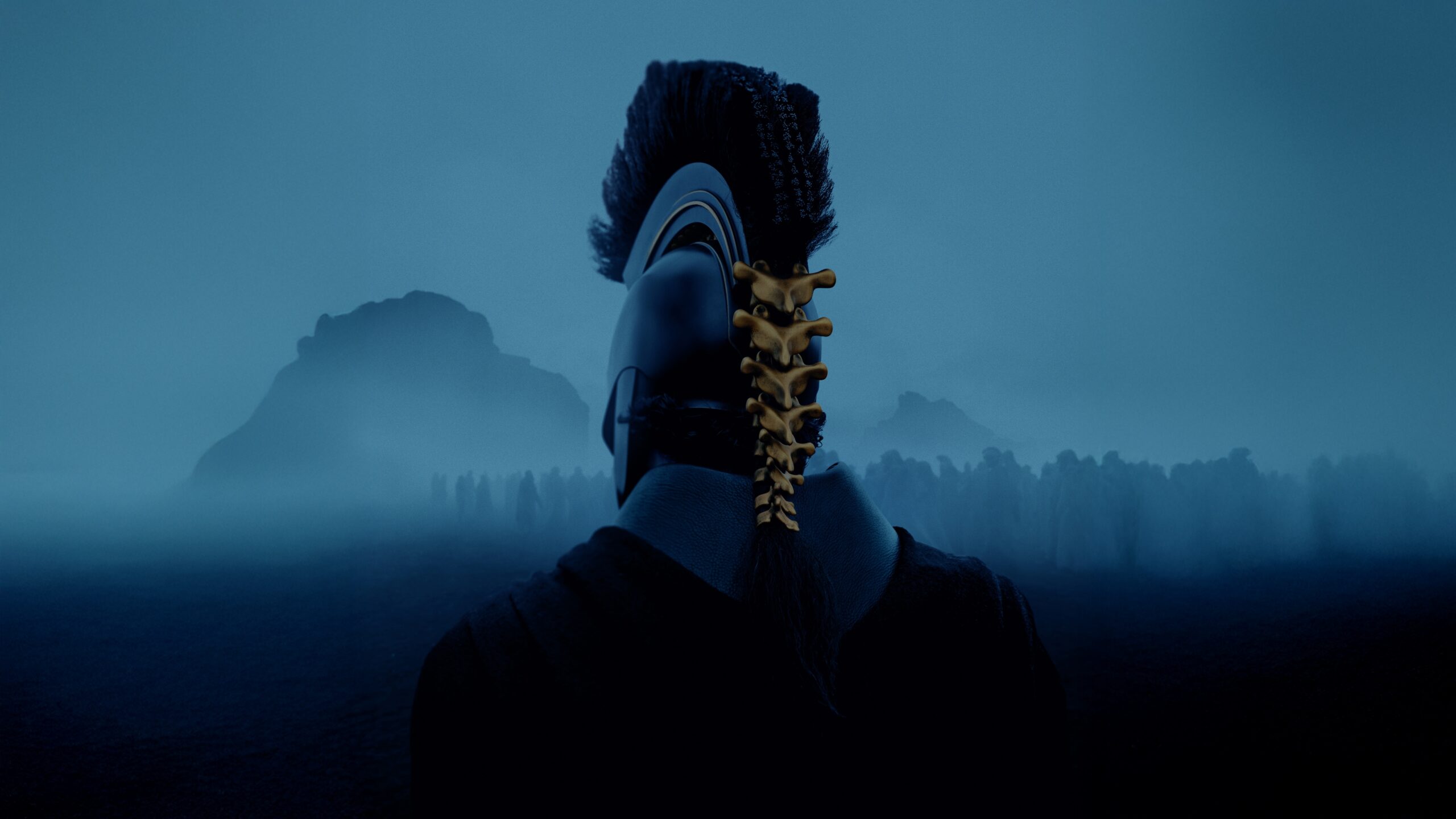
The Odyssey is Christopher Nolan’s best-reviewed film. 96% on Rotten Tomatoes, 89 on Metacritic, and a set of numbers that suggests something rare happened here — a filmmaker at the height of his abilities took the oldest adventure story in the Western canon and made it feel urgent again. It is epic in the actual sense of the word, not the marketing one.
It’s also the reason people go to cinemas. Three hours that don’t feel like three hours. A world you get transported into and live inside. An ending that earns every minute preceding it. Whatever your relationship to Homer, to Nolan, or to the discourse that surrounded this thing for months before release — go and see it, on the biggest screen you can find, and make your own call.
The Cast
Nolan’s Odyssey Is a Horror Film
This is the thing nobody was ready for. Nolan cuts roughly 90% of the gods out of the story and frames the world as one of “apparent magic” — grounded, physical, and all the more unnerving for it. What that produces is a film where every island Odysseus lands on is a fresh nightmare rather than a mythological set piece.
Circe transforms his men into pigs by feeding them tentacles they can’t stop eating, her hands moulding their faces like clay while the footage speeds up, slows down, and runs in reverse. Polyphemus isn’t a fantasy cyclops but something malformed and wrong, still recognisably the son of Poseidon. The Laestrygonians reveal themselves when what looks like a normal soldier turns around and is a nine-foot child. The Hades sequence has bodies rising out of sand and shades drinking blood to speak.
The community reaction to this has been near-unanimous: a lot of people would now very much like Christopher Nolan to make a horror film. On this evidence, they’re right to.
The Trojan Horse
What Nolan Changed
Plenty, and mostly well. The Lotus Eaters are gone, folded into Calypso in a way that softens the story considerably — she’s nursing his fractured mind rather than drugging him, and over seven years she genuinely falls in love with him. Circe’s three children with Odysseus are cut entirely. His men are pissed at him and stay pissed at him, which is a good change that gives the mutiny tension real weight. Poseidon lets him live rather than actively trying to drown him, with a line that Zeus won’t allow it. The bed riddle — one of the poem’s most famous beats — doesn’t make the cut.
The overall effect is a pro-Odysseus reframing that cleans up a lot of what makes him unlikeable and strengthens his relationship with Penelope and Telemachus in exchange. Purists will have opinions. The film is better for most of them.
The structure — told out of order, doubling back to recontextualise earlier scenes — is drawing complaints from some viewers, which is genuinely funny given that’s roughly how the poem has been told for nearly three thousand years.

The Good, The Bad, & The Ugly
| The Good | The Bad | The Ugly |
|---|---|---|
| The Climax Earns EverythingThe bow, the twelve axes, the music building underneath it, and Penelope’s recognition. Then the slaughter. Then the dog. Three hours of setup detonating exactly as designed — Göransson’s score and Nolan’s construction working in complete lockstep. This is why the theatre exists. | The Modern DialogueNolan throws period language out entirely and it’s jarring for the first twenty minutes. Odysseus saying “dad” instead of “father” pulls you out. Most viewers report it fading completely after the opening act — but the choice will lose some people before it wins them. | The End Credits Rap SongLudwig Göransson delivers a career-highlight score across three hours and then the credits roll into a rap track that belongs to a different film entirely. Multiple viewers flagged it independently. Do not leave people with that. |
| Nolan Made a Horror Movie and Didn’t Tell AnyoneCirce’s body horror. Polyphemus as malformation. The inside of the Trojan Horse. The Hades ritual. By stripping out the gods and grounding the myth, Nolan turned Odysseus’s journey into a sequence of genuine nightmares. It’s the film’s biggest and best surprise. | Some Casting Doesn’t LandZendaya’s Athena is both smaller than expected and the performance doesn’t quite connect. Bernthal reads as the Punisher in a chiton. This is a who’s-who cast where a few roles feel filled rather than cast — though none of it breaks the film. | The Colour PaletteFilmed in what looks like Scotland rather than the Aegean, and it shows. Calypso’s island is meant to be a paradise so tempting Odysseus can’t leave — it looks like somewhere you’d want to leave immediately. The green reveal at the end is the only real burst of colour in three hours. |
| Damon, Hathaway, Pattinson, LeguizamoDamon carries the film as a man who is brilliant and repeatedly, catastrophically wrong. Hathaway’s on her best form. Pattinson is magnificently hateable. Leguizamo quietly excellent. When the casting works here, it really works. | The Bronze Age SpeechNolan can’t resist an Oppenheimer moment — Odysseus declaring he personally ended the Bronze Age and broke Zeus’s law. It’s melodramatic, self-important, and unnecessary after the film had already reached its emotional peak. A cherry too far. | Nolan’s Audio, AgainBetter than Tenet, but the storm sequence is still a wall of noise where dialogue simply doesn’t exist. Whether that’s intentional chaos or the same mixing problem Nolan’s been asked about his entire career is a debate that shouldn’t still be happening in 2026. |
The Verdict
The Odyssey is the reason people used to go to the movies, and the reason some of us still do. It’s an event film in the truest sense — a $250 million mythic epic shot on IMAX film, told with total confidence, that transports you somewhere and keeps you there for three hours that don’t feel like three hours.
The flaws are real and they’re mostly small. The dialogue is jarring until it isn’t. A handful of the enormous cast are miscast. The palette is drab where it should be glorious. The Bronze Age monologue is one beat too many. The credits song is a crime. None of it dents the film meaningfully, because when the bow gets strung and the music swells and the dog finally, finally gets to rest — you’ll forget every single one of them.
96% on Rotten Tomatoes is Nolan’s career high and it’s not an accident. This is a filmmaker who wanted to tell this story, told it with everything he had, and brought a three-thousand-year-old poem to an audience that mostly hasn’t read it. Same as he did with Oppenheimer. Go see it. Go see it in IMAX if you can get a seat. Use the bathroom first.
And if Nolan wants to make a horror film next — after Circe, after the Trojan Horse, after Hades — we’ll be seated.
For more movie and TV reviews, check out our full reviews section.