

Every now and then, a game comes along that stops you mid-session and makes you genuinely question what a small team is capable of. Causal Loop, from three-person studio Mirebound Interactive, is that game. Built in Unreal Engine 5 and published by Headup, this sci-fi puzzle platformer arrived in April 2026 and immediately made waves among fans of the genre — and for very good reason.
You play as Bale, an exo-archaeologist who arrives on the alien world of Tor Ulsat alongside his colleague Jen to study the ruins of a lost civilisation. When Bale accidentally activates the Chronolith — an ancient alien device — reality fractures. Jen vanishes, time begins bleeding across itself, and Bale is left alone to piece together what happened to the Tor while battling increasingly mind-bending spatial and temporal puzzles.

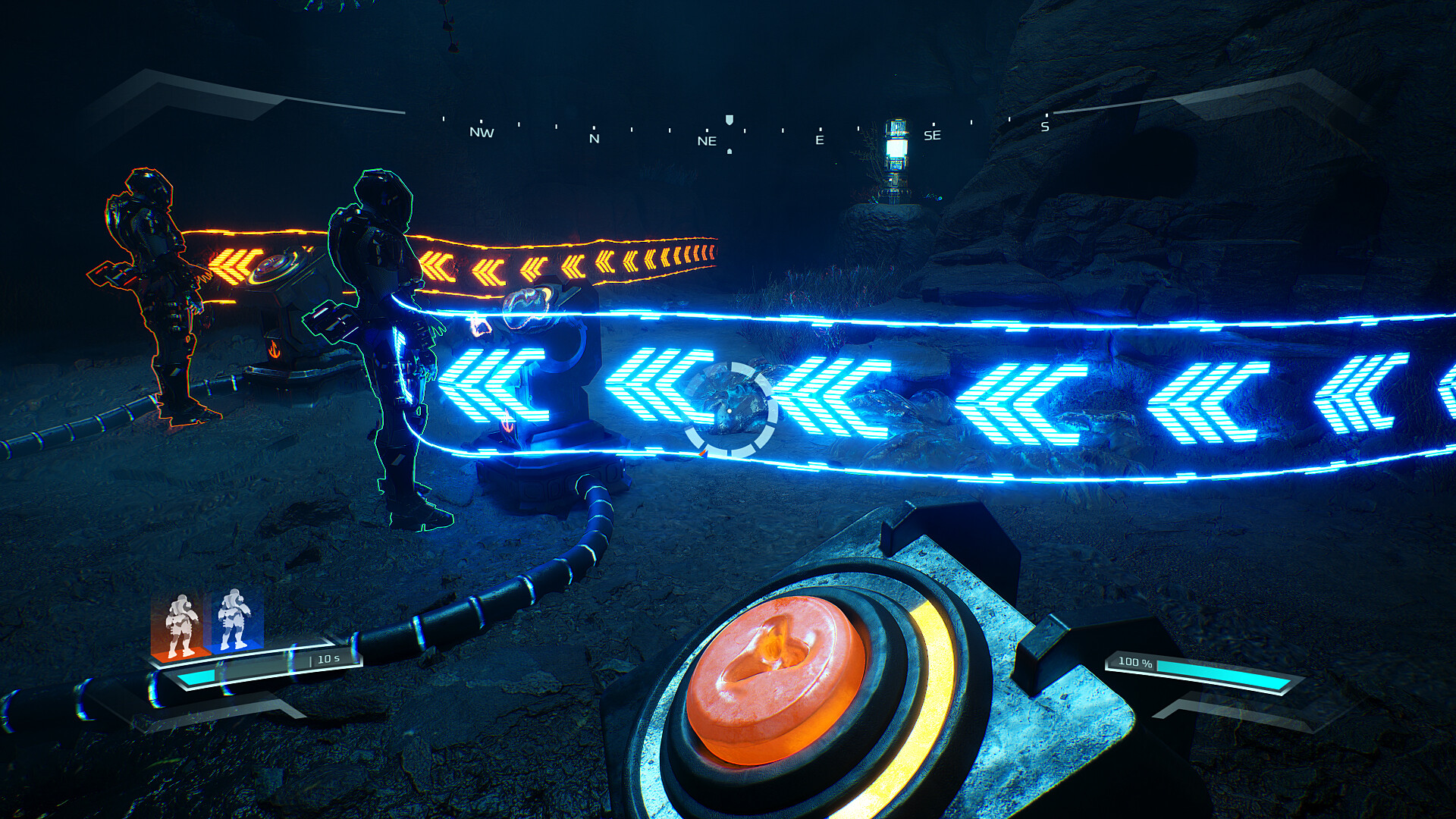
The heart of Causal Loop is its “Echo Branching” system. At any point, you can record your own actions and play them back as an echo of yourself — and you can run up to three echoes simultaneously. These recorded versions of Bale become puzzle tools, holding doors open, activating switches, and interacting with ancient alien systems in ways that would be impossible alone.
It sounds complex on paper, but Mirebound has done an exceptional job of introducing the mechanic with patience and care. The early chapters guide you through the basics at a comfortable pace, gradually layering in new variables — timed keys that expire and explode, branching pathways that only work when multiple echoes coordinate correctly — until you reach a point where you’re essentially programming yourself through time to solve intricate multi-step puzzles.
Comparisons to Portal and The Talos Principle are inevitable and warranted, but Causal Loop earns its place alongside those titles rather than simply borrowing from them. The echo system has a flexibility and depth that genuinely feels like an evolution of the recording mechanic rather than a copy of it. When a puzzle finally clicks — when all three echoes snap into alignment and the solution reveals itself — the satisfaction is immense.
Tor Ulsat is one of the most visually striking alien environments in recent indie gaming. Massive stone structures, luminescent fungi, shimmering energy fields, and the haunting remnants of a lost civilisation are rendered in stunning detail across fifteen hand-crafted chapters. Mirebound has clearly poured enormous love into environmental design, and players who take their time to explore — hunting secrets, scanning alien artifacts, soaking in the atmosphere — will be richly rewarded.
What’s more impressive is that this visual fidelity comes without the usual Unreal Engine 5 performance tax. Players consistently report buttery smooth frame rates with zero stuttering, even at high resolutions and on demanding display setups. That alone would be noteworthy — a UE5 title that actually runs well at launch feels almost miraculous in 2026.
Puzzle games live and die by their moment-to-moment mechanics, but Causal Loop distinguishes itself by weaving a genuinely compelling narrative throughout. The story of the Tor civilisation and what became of them unfolds through environmental storytelling, recovered audio logs, and direct character interaction, maintaining a sense of mystery that pulls you forward even during the game’s more demanding puzzle sequences.
Bale and his AI companion Walter carry much of the game’s personality through sharp, witty banter that draws inevitable comparisons to the Portal dynamic — but the writing here is warm and human in its own right. The voice acting across all characters is strong, and the fully voiced cast gives the world genuine emotional weight. More than one player has noted giggling at the dialogue before being blindsided by a genuinely moving story beat.
Causal Loop’s fifteen chapters offer a well-judged difficulty curve that starts accessible and builds steadily toward genuinely challenging late-game puzzles. The introduction of timed keys — which must be inserted into sockets before they detonate — adds a precision element that some will love and others will find frustrating, particularly when death resets all saved echo loops and forces a restart of complex multi-step sequences.
Some platforming sections push the boundaries of what feels intentional, with jumps that are difficult enough to raise questions about whether there’s a smarter solution being missed. These moments are relatively rare but worth noting for players who prefer their puzzles purely cerebral rather than physically demanding.
| The Good | The Bad | The Ugly |
|---|---|---|
| Echo Branching MechanicA genuinely innovative time-recording system that builds in complexity without ever losing clarity. Among the best puzzle mechanics in recent years. | Precision PlatformingSome puzzle solutions require near-perfect jump timing that can feel at odds with the game’s otherwise cerebral design philosophy. | Echo Reset on DeathDying mid-puzzle clears all saved echo loops, forcing lengthy restarts on complex multi-step sequences. Can be genuinely frustrating. |
| Stunning Alien EnvironmentsFifteen hand-crafted chapters set on a gorgeous alien world packed with secrets, atmosphere, and visual detail that rewards exploration. | Timed Key FrustrationThe countdown key mechanic is clever in design but occasionally punishing in execution, particularly in late-game puzzles where precision is critical. | |
| Outstanding Technical PerformanceA rare Unreal Engine 5 title that runs flawlessly at launch — no stutters, no crashes, and strong performance even at demanding resolutions. | Underused Key Value SystemOne of the game’s sub-mechanics — keys with different numerical values — feels underdeveloped and could have been pushed further. | |
| Witty, Fully Voiced CharactersBale and Walter’s banter is sharp and genuinely funny, with strong voice performances that give the story real emotional weight. | ||
| Exceptional ValueA substantial 10–12 hour campaign with secrets and post-game content for under $20. Feels almost unfairly cheap for the quality on offer. |
Mirebound has gone to considerable effort to ensure Causal Loop is playable for as wide an audience as possible. Accessibility options include motion sickness prevention, colour blindness mode, full control remapping, and several additional toggles that demonstrate genuine care for player comfort. The options menu itself — with support for ultrawide displays, a toggle between XFOV and YFOV, and granular graphics settings — signals a level of attention to detail that puts many larger studios to shame.
Causal Loop is a remarkable achievement. A three-person team has built a game that belongs in the same conversation as Portal and The Talos Principle — not as a pale imitation, but as a genuine peer. The echo mechanic is one of the most inventive puzzle systems in years, the alien world of Tor Ulsat is a joy to explore, and the narrative carries genuine emotional weight bolstered by a strong fully-voiced cast.
Minor frustrations around death resets, precision platforming, and an underused sub-mechanic prevent it from being a flawless experience. But given the team size, the budget, and the asking price, these are genuinely minor complaints. If you enjoy puzzle games, sci-fi narratives, or simply want to see what dedicated indie development looks like at its absolute best, Causal Loop is a must-play.