
Subway Surfers for Speed Demons
There is a very specific, deeply irresponsible fantasy that every motorcycle rider (and many drivers) has had while sitting in gridlock traffic: What if I just pinned the throttle and split the gap? LANESPLIT, a new indie title developed and published entirely by solo creator FunkyMouse, is designed to scratch exactly that itch. Released on January 28, 2026, the game strips away the complexities of career modes, pit stops, and track limits. It offers a singular, razor-focused experience: push a performance bike to its absolute limit through civilian traffic, knowing one wrong twitch of the handlebars means instant death.
As one remarkably astute Steam reviewer described it, it’s essentially “Subway Surfers for clinically depressed adults.” It is an interactive flow-state generator. But is a good “vibe” enough to justify a nearly twenty-dollar price tag?
Achieving the Flow State
When LANESPLIT is firing on all cylinders, it is an intoxicating experience. The core gameplay loop is brutally simple: you pick a map, select your traffic density (ranging from an empty “Zen” mode to a chaotic “Rush Hour”), choose between wet or dry pavement, and hit the gas.
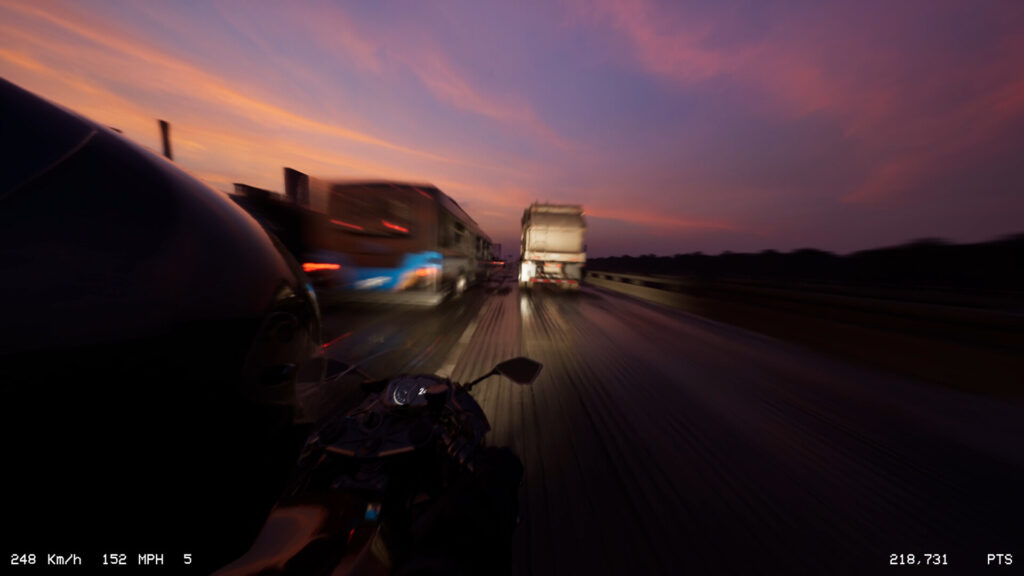
The game’s greatest triumph is its sense of speed. FunkyMouse has masterfully blended motion blur, camera shake, and tight FOV adjustments to make 150 mph actually feel like 150 mph. Threading the needle between two semi-trucks with only inches to spare triggers a genuine spike of adrenaline.
This tension is elevated entirely by the dynamic audio design. As you accelerate, a heavy drum-and-bass soundtrack fades in, growing louder and more frantic the faster you go. If you tap the brakes, the music dips. And if you crash? The music instantly cuts to dead silence, accompanied by a jarring black screen. It is a punishing, highly effective psychological trick that makes you desperate to keep the beat alive.
For purists, the game also offers a manual transmission option. Having to feather the clutch and bang through the gears while calculating trajectory adds a fantastic layer of arcade-sim depth to an otherwise straightforward runner.
Where the Rubber Leaves the Road
Unfortunately, once the initial adrenaline rush wears off, the cracks in the asphalt become glaringly obvious. LANESPLIT suffers from a severe lack of content and a baffling progression system.
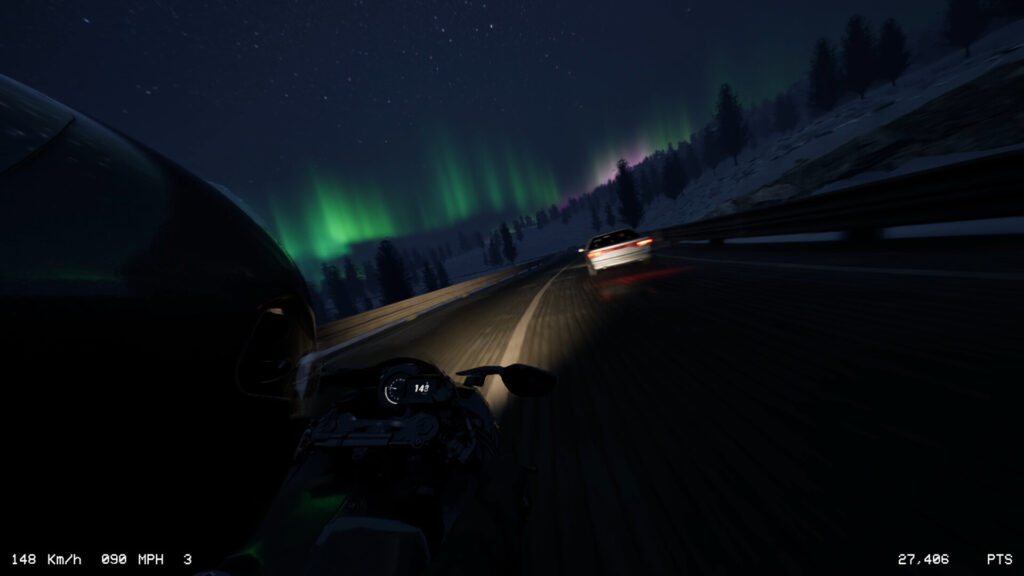
There are currently only three maps in the game: a dusk-lit city loop, a snowy mountain spiral, and an ocean-front highway. While they have different visual filters (leaning heavily into a muted, VHS-style aesthetic), they all play exactly the same. They are endless, straight-ish highways with no real curves or technical challenges.
Worse is how you unlock the game’s 14 different motorcycles. Unlike traditional games, where you earn cumulative currency to buy upgrades, LANESPLIT gates new bikes behind single-run high scores. Because the game resets your score to zero the second you crash or slow down too much, unlocking the late-game bikes requires you to drive flawlessly at maximum speed for literal hours. It stops being a test of skill and becomes a test of sheer, unblinking endurance.
A Collision of Code
As a solo developer’s passion project, some jank is to be expected. But at a full-release price of $17.99, the lack of polish borders on unacceptable.
The game currently feels like it should still be in Early Access. Players have reported:
- Ghost Cars: If you fall off your bike, you will discover that the traffic vehicles have no collision meshes. You can walk right through city buses to find they are completely hollow.
- The Jesus Bike: Due to a boundary glitch on the ocean map, players can accidentally ride their motorcycles out onto the open water, hovering over the waves indefinitely.
- Static Traffic: In a game entirely about unpredictable traffic weaving, the AI vehicles never change lanes. Not once. They drive in perfectly straight, unchanging lines to infinity, effectively turning the game into a static obstacle course rather than a dynamic highway.
The Sound and The Fury
While the drum-and-bass soundtrack is a highlight, the motorcycles’ audio design is a massive letdown. Whether you are riding a nimble 250cc dirt bike or a massive 1000cc inline-four superbike, they all sound incredibly similar. It sounds like a generic, royalty-free recording of a twin-cylinder engine looped endlessly. For a game catering to motorcycle enthusiasts, engine tone is half the fantasy, and LANESPLIT misses the mark entirely.
Furthermore, the game heavily advertises its Online PvP and Co-op modes. Cruising through traffic with friends sounds like an incredible time. However, due to a combination of a low player count and broken, player-hosted server architecture, finding a public lobby is practically impossible right now.
The Good, The Bad, & The Glitchy
| The Good | The Bad | The Ugly |
| Sense of Speed: Visually and mechanically, the game perfectly captures the terrifying thrill of going too fast. | Progression: Locking bikes behind absurdly high, single-run scores makes unlocking content a tedious chore. | AI Traffic: Cars never change lanes or react, turning a dynamic highway into a static, predictable obstacle course. |
| Dynamic Audio: The drum-and-bass soundtrack tying its volume to your speedometer is a stroke of design genius. | Content Desert: Only three maps that all feel functionally identical. | Bugs: Clipping through hollow buses and hovering over the ocean breaks any sense of immersion. |
| Manual Gears: Adds a much-needed layer of skill and engagement to the driving mechanics. | Engine Sounds: Every bike sounds like the same generic, muffled lawnmower engine. | Ghost Town: The heavily advertised multiplayer lobbies are currently completely dead. |
Should You Buy It?
Yes, if: You love infinite runners, listen to breakcore/drum-and-bass regularly, and just want a simple, vibey game to zone out to for short bursts after work.
No, if: You expect realistic motorcycle physics, deep customization, varied track design, or a bug-free experience for your eighteen dollars.
Recommended for fans of: Mirror’s Edge, Descenders, Trackmania, Traffic Rider (Mobile).
LANESPLIT: LANESPLIT is a brilliant concept trapped in a prototype's body. The developer, FunkyMouse, clearly understands the psychology of speed and the addictive nature of the "flow state." When you are in the zone, cutting up traffic to a pounding bassline, the game is a 10/10 experience. But you cannot ignore the hollow car models, the repetitive three-map structure, the lack of meaningful progression, and the generic engine sounds. It is a fantastic foundation that simply isn't a complete video game yet. If you want a digital fidget spinner to turn your brain off for 20 minutes after work, it might be worth picking up on a deep discount. Otherwise, keep this one on your wishlist until the developer drops a few more major patches. – ColdMoon