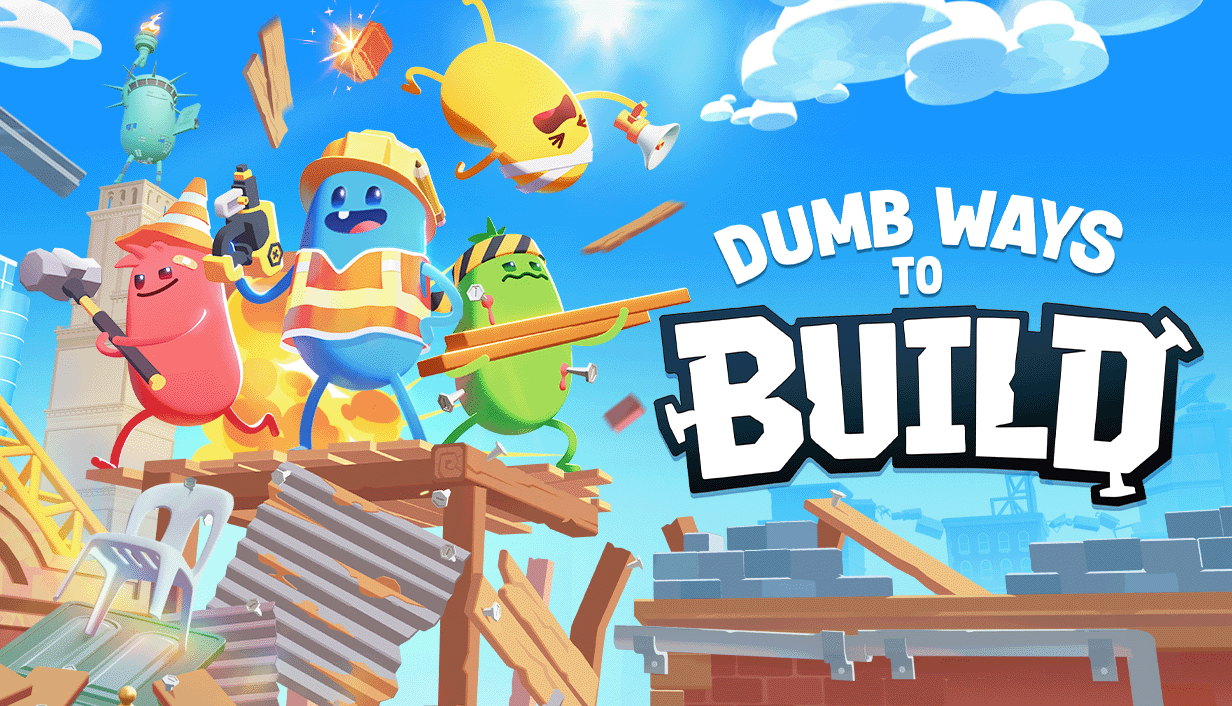
Game: Dumb Ways to Build
Developer: Dumb Ways to Die
Publisher: Dumb Ways to Die
Genre: Physics-Based Co-Op Builder
Released: September 10, 2026
Platform: PC (Steam)
Price: $7.99
Players: 1–4, online co-op with crossplay
Steam Deck: Verified
Install: 7 GB
$7.99Price
3Crisis Jobs
25Achievements
15Languages
855Playing Now
🔨 Know this first: every tool that helps you can also be used on your friends. That isn’t an exploit — it’s the design. The nail gun builds bridges and it also pins people to walls. The sledgehammer clears beams and it also launches your mate off a roof. The store page says it outright: your co-workers are the real occupational hazard.
⚖️ Dual-Use Tools Are the Whole Joke
Most co-op builders give you construction tools and trust you to build. Dumb Ways to Build gives you construction tools and assumes you won’t.
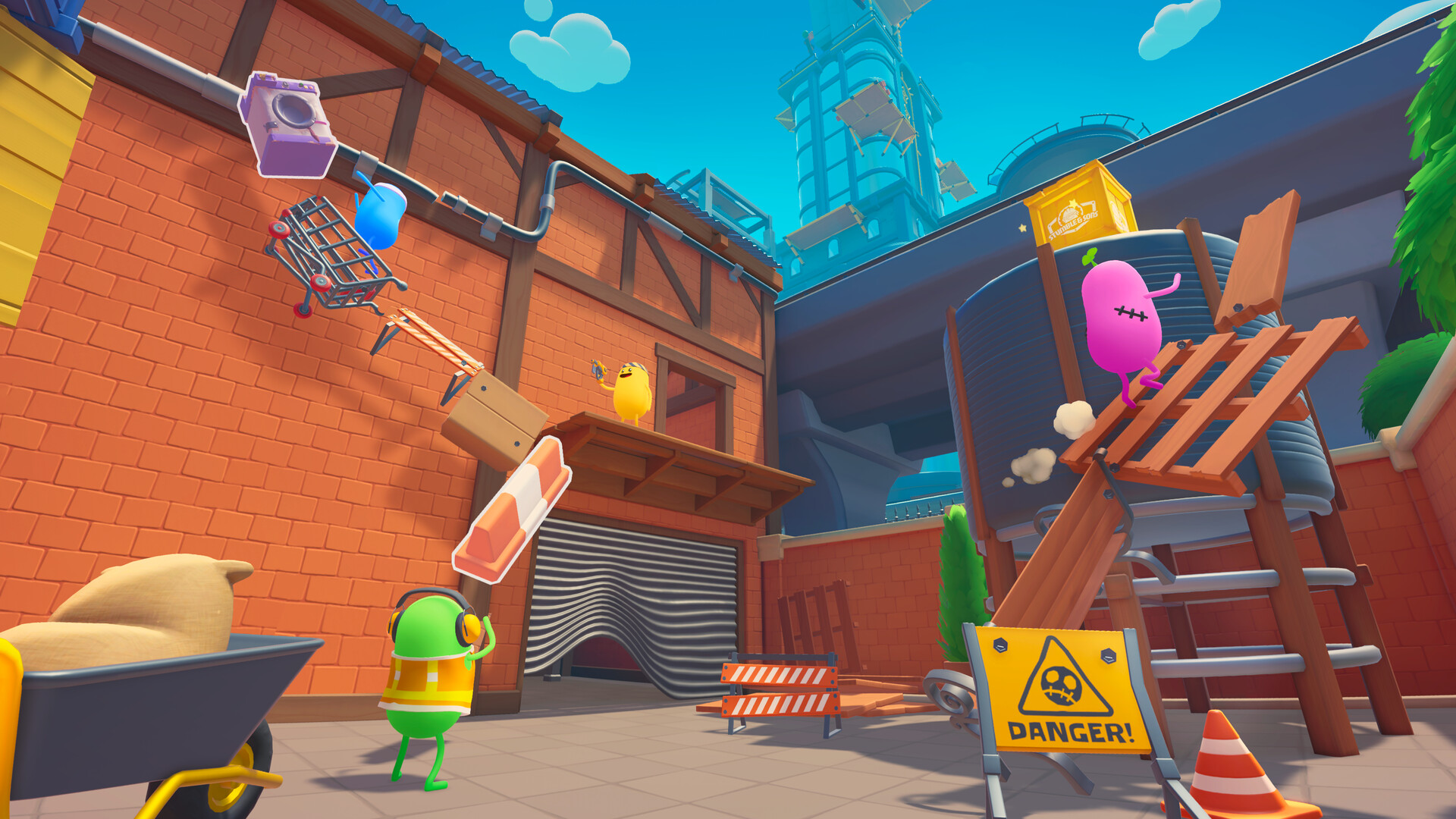
You’re a crew at Dumbville’s least reputable construction company, taking jobs no sane builder would touch. You grab, rotate and throw anything not bolted down, then fire a nail gun to staple together sketchy bridges, ramps and platforms until you’ve built a path out of the jobsite.
Every item in that tool belt is dual-purpose by design. The developers frame the choice themselves: will you take a sledgehammer to that steel beam, or “accidentally” launch your buddy off a roof?
Players are extremely clear about which one actually happens. One summed it up as “lots of laughs and tears when your idiotic friends betray you and shoot you off a plank or tightrope just for funsies.” That tension — genuinely needing each other while being armed against each other — is what separates this from every other four-player physics builder.
All the gear and no idea
“Built it. It collapsed. Built it again. It collapsed with confidence. Somehow, it still worked.”
Dumb Ways to Build is a physics-based co-op game from the Dumb Ways to Die team, out now on Steam at $7.99. It launched on September 10 and sits at Very Positive across 206 reviews, with a healthy 855 players in-game as we write.
Our verdict: This chaotic co-op builder is pure comedic mayhem that demands friends and patience in equal measure. If you enjoy physics-based destruction with laughs over logic, it’s absolutely worth your money. There’s just not very much of it.
It’s Funnier Than It Has Any Right to Be
😂 The Reviews Are Doing Stand-Up
You can usually tell how a comedy game landed by how people write about it, and the Dumb Ways to Build review page is unusually funny:
“This game taught me that I am not an architect, engineer, builder, or even someone who should be trusted with a hammer.”
“I downloaded this game expecting to build tall things. Instead I built resilience and several new reasons to question my intelligence. 10/10 character development.”
That’s the register the whole thing operates in — cheerful incompetence as a shared activity. It helps enormously that the Dumb Ways to Die brand already has fifteen years of that tone banked, and players single out the references to the original song as landing properly rather than feeling bolted on.
Mechanically the joke has teeth too. Players report that despite the chaos, it “requires some real thinking at a few certain moments and some accurate aim.” The comedy comes from failing at something that’s genuinely solvable, which is a much better joke than failing at something arbitrary.
🔫 Nail Gun
Staples anything to anything. Bridges, ramps, structures — and occasionally a colleague.
🎤 Proximity Chat
Coordinate the crew, or just listen to the carnage unfolding somewhere below you.
🚧 Crisis Jobs
Hazard-filled maps with hidden secrets, unlockable cosmetics and extra challenge modes.
🫘 Bean Customisation
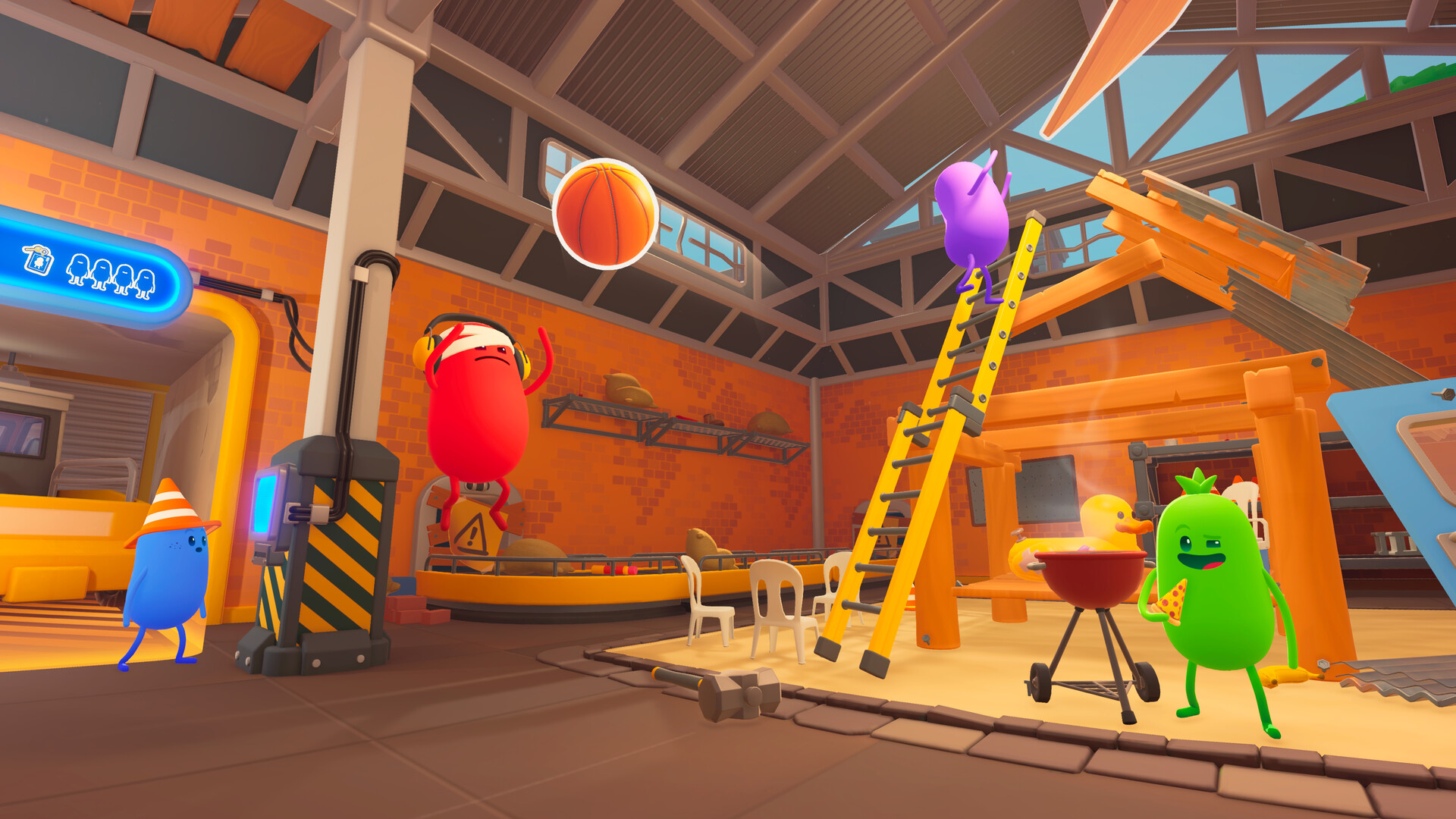
A truckload of unlockable cosmetics for your Bean. Players say the lobby is half the fun.
Three Levels Is the Problem
📏 Everyone Says It, Including People Who Love It
The one criticism that appears again and again across an otherwise glowing review page: there are only three Crisis Jobs.
“A bit too short. Hope they will add more levels or add the option to create custom runs.”
“The game is really fun, the only big issue that I have is levels. The game only has 3 levels. If the devs keep making levels and let us create our own and publish via Workshop, it will be great.”
“A little short, but super fun with friends!”
The fix players keep proposing is the same one every time: a level editor with Steam Workshop support. And for a physics sandbox where the joy comes entirely from improvising routes through a hazardous space, that’s exactly right — the tools are the fun, and more spaces to misuse them in costs the developers far less than building every map themselves.
There is meaningful replay built in — hidden secrets in each map, unlockable cosmetics, and extra challenge modes — so three jobs isn’t three sittings. But if you and three friends play regularly, you’ll see everything faster than you’d like.
Check Your Specs Before You Buy
🖥️ This Asks More of Your PC Than an $8 Party Game Should
A player put it bluntly: it’s “fun if you have a group of friends, a decent PC, and eight dollars.” The spec sheet backs that up.
Minimum requirements: a 4-core / 8-thread CPU (i3-10100 or Ryzen 3100), 8 GB of RAM, and a GTX 1060 6GB or RX 580 8GB with 4 GB of VRAM, on a 7 GB install and a broadband connection.
That’s a considerably higher floor than most party games set, and it matters because the party-game audience is exactly the audience most likely to be on an older laptop. If you’re rallying four friends, the weakest machine in the group decides whether this works.
The good news: it’s Steam Deck Verified, which is a genuinely useful data point — if it runs properly on Deck hardware, plenty of modest desktops will manage. But check before you tell everyone to buy it.
The Package Is Quietly Generous
For eight dollars, the technical side is better appointed than it needs to be. Cross-platform multiplayer, proximity chat, Steam Deck Verified, full Xbox and PlayStation controller support, 25 achievements, and fifteen languages for interface and subtitles.
That last one is worth pausing on. Fifteen languages is a serious localisation investment for a game at this price, and it’s the kind of thing that only happens when a publisher expects an international audience — which, for a brand born from an Australian rail safety campaign that became a global phenomenon, is a reasonable bet.
And unlike a lot of small co-op games, it has found an audience. Ten days after launch it’s holding around 855 concurrent players against an all-time peak of 1,499 — which means you can actually find games, and your friends can find you.
Things to Know Going In
📋 Setting Expectations
• $7.99, and it has already dipped to around $6.91 since launch. Three bundles exist at $14.38 each if you want it paired with other Dumb Ways titles
• Very Positive across 206 reviews, with an active playerbase ten days in
• Three Crisis Jobs currently. This is the main complaint and you should weigh it before buying
• 1–4 players online, with crossplay. Solo Play exists, but every single positive review is about playing with friends — treat solo as a bonus rather than the point
• Proximity chat is built in, and it’s central to the comedy. Bring people you’ll enjoy hearing scream
• Steam Deck Verified, with full controller support for both Xbox and PlayStation pads
• ⚠️ A GTX 1060 6GB minimum with 4 GB VRAM — high for a party game. Check the weakest PC in your group
• Fifteen languages for interface and subtitles
• The lobby has things to do, which players mention approvingly — downtime between jobs isn’t dead air
• Requires agreement to a third-party EULA, and the store flags in-game chat and online interactivity
• Actively supported — updates and bundle announcements have landed within the first fortnight
The Good, The Bad, & The Ugly
| The Good |
The Bad |
The Ugly |
| Every Tool Cuts Both WaysThe nail gun builds bridges and pins people to walls. The sledgehammer clears beams and launches colleagues off roofs. Needing each other while being armed against each other is the whole design, and it’s what separates this from every other four-player physics builder. |
Solo Is Beside the PointSolo Play exists, but not one positive review is about it. This is a game about hearing your friends make terrible decisions in real time — alone, most of the appeal evaporates. |
Only Three Crisis JobsThe one complaint that appears across an otherwise glowing review page, including from people who love it. Secrets, cosmetics and challenge modes stretch it — but a regular group will exhaust the content faster than they’d like. |
| Genuinely, Properly FunnyThe reviews read like stand-up — “I built resilience and several new reasons to question my intelligence” — and the Dumb Ways to Die tone lands, song references included. Better still, the comedy comes from failing at solvable problems rather than arbitrary ones. |
It Needs the Right FriendsOne player’s “enjoyable with friends (Sometimes)” says it. A group that finds betrayal funny will have a brilliant time; a group that finds it annoying will fall out by the second job. |
A GTX 1060 Minimum on an $8 Party GameEight gigs of RAM and 4 GB of VRAM is a high floor for exactly the audience most likely to be on an ageing laptop. Steam Deck Verified is reassuring — but the weakest machine in your group decides whether this works. |
| Cheap and Technically GenerousCross-platform multiplayer, proximity chat, Steam Deck Verified, both controller brands, 25 achievements and fifteen languages — at $7.99. The localisation investment alone is unusual at this price. |
No Level Editor YetPlayers keep asking for one with Workshop support, and they’re right to. In a physics sandbox where the tools are the fun, more spaces to misuse them in is the cheapest possible content. |
—Nothing else recurs. No crashes, no netcode complaints, no broken systems in anything we read — the criticisms are about volume and hardware, not build quality. |
| It Actually Has Players855 concurrent ten days after launch against a 1,499 peak, with active updates and bundles already shipping. For a small co-op game, finding a match being a non-issue is worth more than most features. |
— |
— |
The Verdict
Dumb Ways to Build understood the assignment. Handing four people a nail gun, a sledgehammer and a shared objective, then stepping back, produces exactly the kind of chaos the Dumb Ways to Die brand has been mining for over a decade — and crucially, the underlying puzzles are real enough that failure is funny rather than arbitrary. You’re not losing to randomness. You’re losing because your friend decided the steel beam was better used as a projectile.
It’s also a genuinely well-appointed package for eight dollars. Crossplay, proximity chat, Steam Deck Verified, both controller brands, fifteen languages — plenty of games charging three times as much manage less. And it’s found a playerbase, which for a small co-op title is the difference between a purchase and a regret.
The ceiling is content. Three Crisis Jobs is thin, and the fact that nearly every positive review mentions it tells you how much people want more. The secrets, cosmetics and challenge modes give you reasons to return, but a group that plays weekly will see the bottom of this quickly. The level editor players keep asking for is the obvious answer, and in a sandbox where the tools are the game, it would multiply the value enormously.
The honest read: buy it, but check the specs first. A GTX 1060 minimum is steep for a party game, and the weakest PC in your group is the one that decides. If everyone clears that bar, eight dollars for this much laughter is an easy yes — and the bundles are worth a look if you want more of the same.
Just don’t expect it to fill a whole month. Expect it to ruin three evenings brilliantly.
For more game reviews, check out our full reviews section.
Score Breakdown
Steam Deck & Cross-Platform9.5/10
Co-Op Chaos & Humour9.0/10
Localisation Breadth9.0/10
Physics & Building Systems8.5/10
Hardware Requirements5.5/10
Final Score
8.0/10
Dumb Ways to Build — Dumb Ways to Die
It’ll ruin three evenings brilliantly
Related