
Let me get this out of the way first: Blue Prince absolutely deserves its accolades. This is a phenomenal puzzle game that will fester in your brain like a virus, unlocking key puzzles hours after you first encounter them. It sits at the intersection of playing a game on a screen and playing a game in your own mind, and I cannot recommend it enough to anyone who loves an escape room, a mystery box, or a good puzzle book.
Fair warning, though — it may end up overtaking whatever free hours you have left at the end of the day. The reputation is real.
After the passing of Baron Sinclair, you play as Simon, his chosen successor. The Mount Holly Estate and its associated titles are yours if you can reach the mysterious 46th room of the manor. Given that there are only 45 rooms, and that the layout of the house changes every day, this is a task rather easier said than done.
The Loop
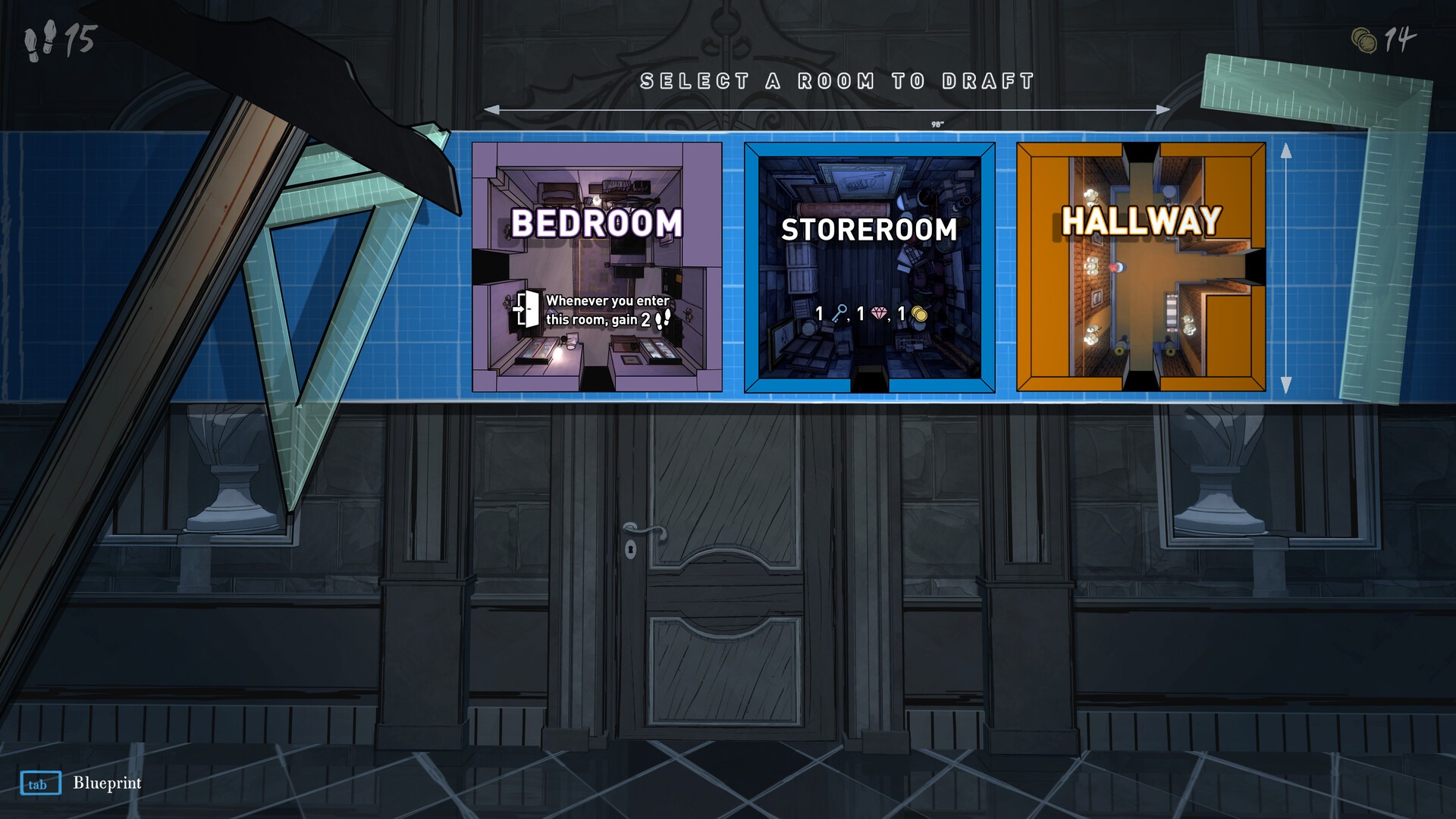
Every door you open offers a choice of three rooms with different connecting doors. Certain rooms favour certain parts of the manor, but every door is still a roll of the dice.
Rooms hold gems and other resources you spend to draft rooms with extra doors or benefits. Nothing matters more than keeping enough in hand to keep moving.
Rooms are colour-coded by type. Red rooms, for instance, tend to carry detrimental effects that follow your draft for the rest of the day.
The game recommends a physical notebook, and it isn’t joking. Mine ran to nearly twenty pages of scribbles, doodles and charts by the end.
A Game Built Entirely Out of Choices
I think games are at their best when you as a player are making choices. Much like characters in film, choices are what define us. In play, a choice is what reinforces your connection to the rules of the game — kicking a ball at a specific moment in a football match changes how everyone else in the game responds.
The masterstroke of Blue Prince is that every choice is clearly communicated beforehand, and you are forced to weigh each and every door, because once you unlock a door you have to add a room. The game is randomised, but it is always determined by the player’s choice. It’s a subtle distinction and it’s absolutely key to figuring out how to navigate Mount Holly’s endless hallways.
That’s the actual game playing out on the screen in front of you: choices, and what they mean for how you play. And the thing about Blue Prince is that this is only half of it.
Onions, Boxes, and Red String
Onions, as you are no doubt aware, have layers. Blue Prince is an onion, wrapped in boxes, at the centre of a labyrinth, inside an escape room. The sheer amount you can learn about this world — through objects, letters, notes, art and much more scattered across the drafting pool — is astonishing.
This is the true heart of Blue Prince, and it’s what will keep puzzleheads enthralled for a very long time. Cracking a hidden password, or simply understanding a person’s relationship to someone else based on photos and notes left lying around, produces a specific kind of delight that very few games manage.
Where the Design Fights Itself
I would be remiss not to mention that Blue Prince can also feel like a repetitive mess, and the roguelike structure is the reason. Running into consecutive dead ends is demoralising at the best of times — it’s considerably worse when you have already worked out exactly what you need to do next and simply cannot get there.
I don’t think Blue Prince can have its cake and eat it too. There are plenty of strategies you can deploy to plot an optimal route, only to be cut off by a no-win layout right before the end. The only reason I reached the game’s conclusion was by over-preparing for every eventuality, and even then it still came down to a matter of chance.
This is where the game is at odds with itself. It’s ultimately why I still prefer something like Lorelei and the Laser Eyes, which plays with similar design intent — but because Lorelei is a puzzle game with a set number of solutions, its world and characters grow alongside the player’s understanding. Blue Prince, by contrast, can often be a fight against the design of the game itself.

The Good, The Bad, & The Ugly
| The Good | The Bad | The Ugly |
|---|---|---|
| It Plays in Your HeadBlue Prince is as much a game you play in your own mind as on a screen. Puzzles unlock hours after you first encounter them, often while you’re doing something else entirely. Very few games achieve this, and none quite like this. | Repetition and Dead EndsThe roguelike structure means consecutive dead ends are inevitable, and they’re genuinely demoralising when you already know what you need to do and simply can’t reach it. The loop can grind. | The Ending Needs LuckI only reached the conclusion by over-preparing for every eventuality, and it was still down to chance. Determination and perseverance aren’t enough on their own — you also need the draw to cooperate. |
| Choices That Actually MatterEvery door is a clearly communicated decision, and unlocking one commits you to adding a room. Randomised, but always determined by the player. It’s a subtle bit of design and it’s the whole foundation. | Strategy Undone by the DrawYou can plot a genuinely optimal route and still get cut off by a no-win layout right at the end. The game asks for planning and then occasionally refuses to honour it. | The True Ending Isn’t for EveryoneSeeing everything through takes a level of commitment many players won’t have. I reached the credits satisfied without unravelling every layer, and I completely understand players who feel short-changed by that. |
| Astonishing Environmental StorytellingThe Sinclair family, the Reddington estate, the objects and letters and art — every room feeds the corkboard-and-red-string feeling. Cracking a code or piecing a relationship together from scattered photos is deeply satisfying. | At Odds With ItselfLorelei and the Laser Eyes does something similar and lets its world grow alongside your understanding. Blue Prince can instead become a fight against its own design — brilliant and obstinate in the same breath. | It Will Eat Your Free TimeNot really a flaw, but a genuine warning. The reputation for consuming players’ lives is entirely earned. Budget accordingly, and be grateful the Switch 2 lets you suspend it mid-thought. |
The Verdict
Blue Prince masterfully blends strategy and puzzle-solving into a captivating adventure that keeps you guessing with its ever-shifting Mt. Holly setting. Even if you don’t ordinarily enjoy the roguelike genre, this is an astonishing achievement. At its heart it’s a puzzle game unlike any other — you aren’t simply solving puzzles, you’re actively making choices and feeling their impact reverberate through the whole experience.
It isn’t flawless. The randomisation can turn a well-planned run into a dead end, and the road to the true ending demands more luck than I think good design should ask for. Those are real problems, and they’re the difference between a great game and a perfect one.
The warning signs were there and they’re all true: Blue Prince can take over your life if you don’t watch out. But I say let it. Step into this manor over and over again, get swept up in the mysteries of the Sinclair family, and keep pushing forward. Whether you stay long after the credits roll is entirely up to you.
What I can guarantee is that this is a genuinely unique game in every sense of the word. It will be the benchmark future puzzle games are measured against — and that is no small feat. If you’ve been waiting for the right moment or the right platform, the Switch 2 version is exactly that.
For more game reviews, check out our full reviews section.